Tuesday, June 3, 2008

Last Night: An Almost Burgundian Dinner.

Prologue: ABCs of Pommard's Premier Cru Epenots, a.k.a., Epeneaux:

The most famous wines of Burgundy come from the Côte d'Or, which is divided into the Côte de Nuits and Côte de Beaune, where all reds are made with pinot noir grapes. In Burgundy's Côte d'Or, unlike in Bordeaux, "grand cru" is the highest classification, a notch above "premier cru". Pommard is a village in the Côte de Beaune and their typically masculine, robust, somewhat rustic, earthy reds are generally considered as the longest-lived wines from the Côte de Beaune.

Among the 1990s better vintages for Côte d'Or reds (1990, 1993, 1995, 1996, 1997 and 1999), 1993 is recognized as exceptionally good.

Comte Armand is generally accepted as the best Pommard domaine and Clos de Epeneaux is its top bottling. As I understand, the subject clos (a walled/enclosed vineyard) is a monopole (i.e., wholly owned) of Comte Armand, unlike most Burgundy vineyards which are complicatedly shared by several different owners. The same premier cru classified vineyards are usually referred to as "Epenots" or "Grands Epenots". Only Comte Armand uses "Epeneaux", likely, because it is a monopole and/or considers itself a cut above the rest...and with good reason. Armand's Epeneaux is considered by many as equal to grand cru in quality.

I have old notes on 2 vintages of Comte Armand's Pommard 1er Cru Clos des Epeneaux:

2000 Pommard Clos des Epeneaux by Comte Armand - Opened during a dinner on March 21, 2007 at Je Suis Gourmand , paired with roasted French pigeon. This medium-bodied wine started off promisingly with nice, earthy profiles of faintly spiced berries (slightly more red than black) and beets, slight gaminess, well-integrated wood. It was drinking quite nicely, good focus, even some glimmers of elegance. I kept thinking it would open up more, kept checking every few minutes, but it just started sliding after around 45 minutes to an hour, its aromas diffusing and flavors separating, its finish drying out. I expected much more from this.

1996 Pommard Clos des Epeneaux by Comte Armand - From the Doc, 4th December 2007 at Tivoli. I personally have a soft spot for these earthy, masculine reds from the Cote de Beaune (though I was somewhat disappointed with the vintage 2000 version of this wine). Quite lively yet 11 years from vintage - livelier/more youthful than I expected it to be (or could it be that my judgment was clouded by unavoidable contrast to the 2 previous wines?) - a muscular red Burg with an intriguing vague hint of iron to its hallmark earthiness. This one was comparatively much easier to analyze: a smooth compote of red fruit, red cherry and discreet ripe dark raspberry over red beet undertones - more satin than silk on the palate. Good, sturdy, solid Pommard bones and structure.Very nice and I believe this will continue to age gracefully for another, perhaps, 5 years. Admirable ageworthiness.


We (the Doc, Stockbroker and myself) intended last night's dinner at SALA to be all Burgundy, and I insisted on opening my bottle of 1993 Comte Armand Pommard 1er Cru Clos de Epeneaux. Unfortunately, from the get go, I noted that the wine was a murky, brownish red color - alarm bells went off - this is normally a telltale a sign of damage by heat, over-oxidation or both. The bouquet smelled like an old red Burg's should be (with faint suggestions of decay and old violets to its fruit), but a couple of experimental sips presented a souring finish. I decanted it, hoping against hope that it would somehow revive itself, but it was useless. We set the wine aside.

Fortunately, the Stockbroker, remembering the normal risks of buying aged Burgundies, thought to bring a back-up red. No Burg this, it is from California but also made from pinot noir. Those who watched the movie Sideways will recall that this winery's pinot noir was prominently featured during the dinner scene at the Hitching Post where Miles (Paul Giamatti) first dated Maya (Virginia Madsen).

With Snake River Farm Wagyu steaks for them and roast duck breast on lentils for me:
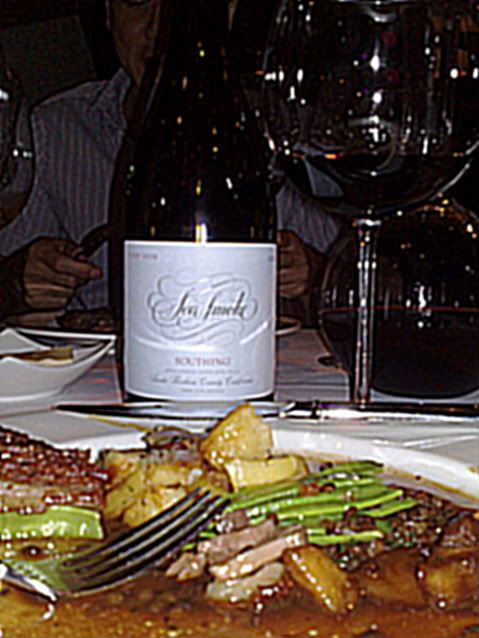
2002 Sea Smoke Southing - A beautiful, darkly reflective red with a midnight red-violet core. The aromas, initially vaguely truffled and very earthy, are generous with ripe, dark red berries (cherry, raspberry and some strawberry), spice (hints of cinammon), vanilla/oak; all of which were richly and enthusiastically mirrored on the palate in a confidently full body with a touch or kirsch and subtle chocolate and violet undertones. Long and strong, its finish was consistent with its middle. No real mystery or profound complexity here, but a lot of up-front entertainment.

Notably, cola notes, usually at the forefront of California pinot noirs, were barely noticeable. I think this is a good thing. Typically Californian, this wine cannot fairly be accused of refined subtlety or quiet elegance.

I doubt anyone will ever mistake it for a Burgundy, nor should anyone ever expect to. Cali pinot is a totally different animal - more about lively enjoyment and boisterous laughter rather than deep, somber conversation. Each has its place.

As regards the pairing, as can be seen in the picture, the duck is richly sauced. Carlo Miguel's dishes are robust, enthusiastic and can reach the level of no-holds-barred decadence. Thus, the Sea Smoke was a good, serendipitous match as it easily held its own against my main course. I'd imagine this duck in its sauce would probably have overpowered a 15-year old Pommard.

Prior to that, we enjoyed another treat from the Stockbroker (he really rescued last night's dinner). With my starter of Twice Baked Prawn and Goat Cheese Soufflé:
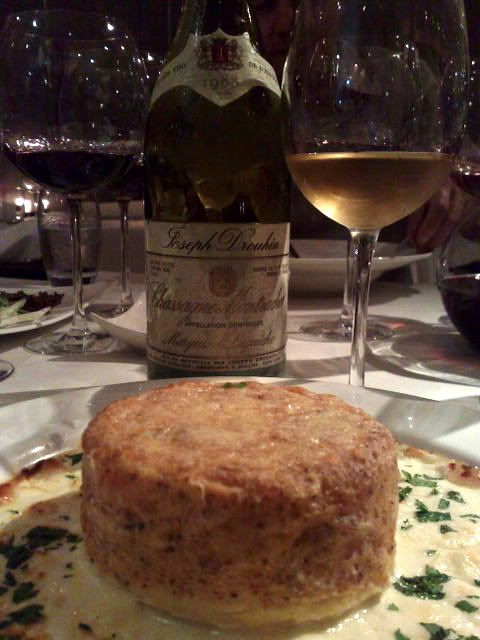

1988 Joseph Drouhin Chassagne-Montrachet Marquis de Laguiche - If served blind, I honestly think I would have guessed this to be a Corton-Charlemagne (because of its clean/pure middle, underlying minerality and forward attack) or a Puligny-Montrachet (because of its notable refinement) rather than a normally saucily-plump-bottomed, more extracted Chassagne-Montrachet. I excuse myself by admitting I don't have any material experience with 20-year old white Burgs - the oldest I can recall offhand (but my memory, admittedly, isn't what it used to be) is a '92 Corton Charlemagne.

After material breathing, I noted the evolution of lemon custard notes in its bouquet. It reminded me of the lemon merengue pie my late mom used to bake when I was in elementary school. It was my favorite dessert. Unfortunately, this was towards the end of the evening and there was none more to be had.

Again, many thanks to the Stockbroker for saving the day and the short trip down memory lane.

Sunday, June 1, 2008

Chinese Cuisine Paired with Wines from Sauternes & Barsac?!?

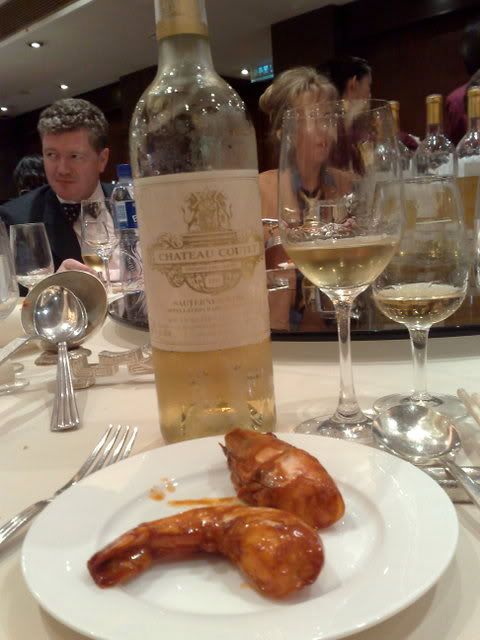
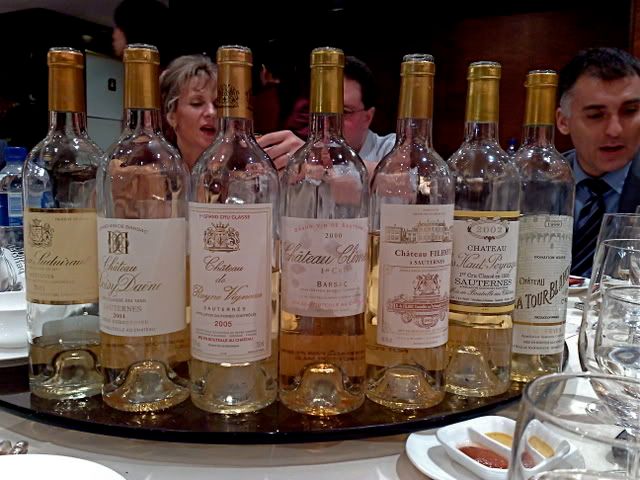
This was the question that came to mind when Edouard told me that fellow EO (HK Chapter) member, Judy Leissner, CEO of Grace Vineyards, invited us, together with our wives, to a Chinese banquet (a.k.a., a "lauriat") to be paired with 10 wines from Sauternes and Barsac. It was a dinner held on Thursday night (29th May) the last day of Vinexpo 2008 HK, at Yung Kee, a venerable HK restaurant that I make sure never to miss whenever in town.

Note: Since all these wines basically share many primary flavors, I will dispense with detailed descriptions and concentrate on my impressions of them as wines from the said regions.

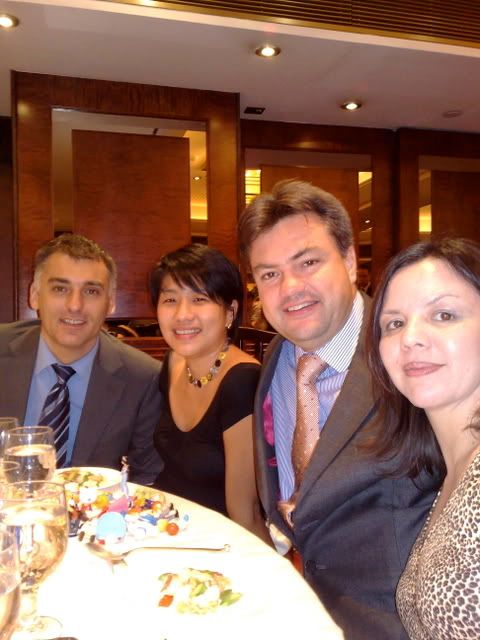
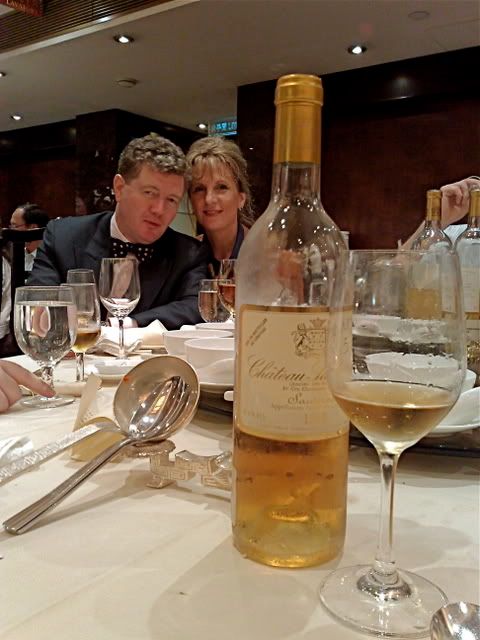
L-R: An ITB French fellow based in China whose name escapes me, Judy Leissner, Edouard and my wife.


The Wines & Food:

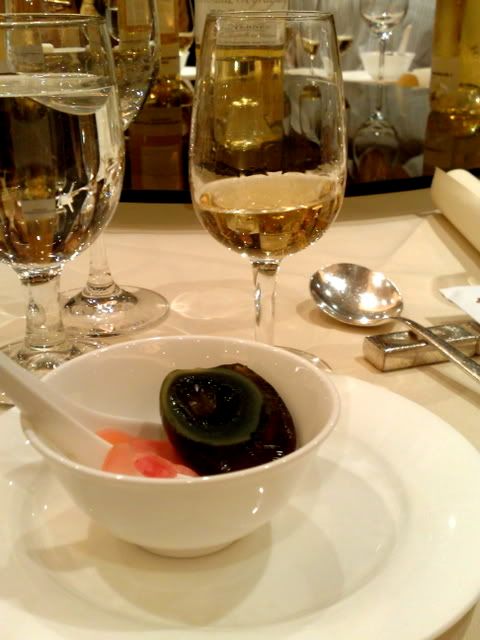
2002 Clos Haut-Peyraguey - Paired with Yung Kee's famous hundred-year-old egg and (sweetish-tart) preserved ginger. At the outset, without having tried it yet, I thought this pairing way too strange.


After giving it a try, however, the rich creaminess of the egg's yolk bound beautifully with the wine's caramel/candied apricot underbelly, with the sweetness taking over at the finish and the acid keeping the palate from fatigue. I suppose this match parallels pairing foie gras with Sauternes. A revelation for me.

2004 Doisy Daëne - Paired with Fried Sliced Chicken with Ginger and Pineapple.


Just reading the ingredients, I could mentally get the pairing: I thought of the ubiquitous Lemon Chicken and Hawaiian Chicken with Pineapple, as well as the preserved ginger and pineapple notes of Sauternes/Barsac wines. I've never really been impressed with the wines of Doisy Daëne, generally finding them simple, sweet, shallow though pleasant enough - fluff really, nothing ever serious. That night was no different, I found it charming enough but comparatively superficial and lacking in acidity. I know it's young though, so it's not really fair to judge it now.

2001 Suduiraut and 2005 de Rayne Vigeau - Paired with Millenarian Salad a la Hong Hong.


I really didn't know what to make of the pairing, it was a bit muddled for me (too many things going on with no definite underlying theme or message I could grasp), the wines were both very nice but I felt no real synergy between them and the dish. I must have chosen the wrong wine to pair.

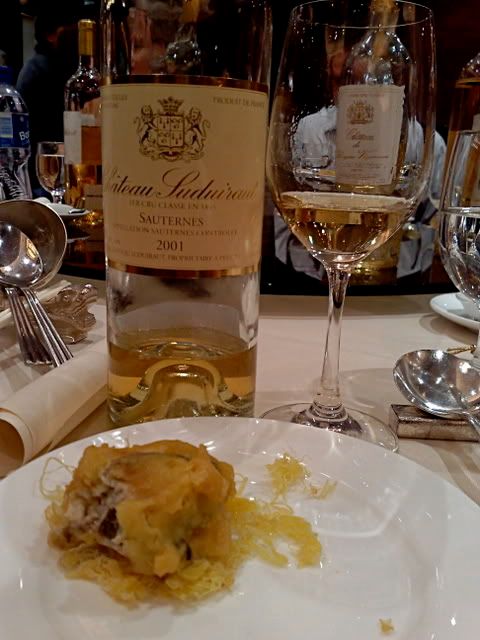
The 2001 Suduiraut was easily the best of the 10 wines (slightly edging over the expansive/voluptuous 1998 Guiraud, the playfully light and complex 2000 Climens and the elegant/floral 1996 Coutet), confidently displaying superior body, weight, authority, depth and length to its delicately spiced dried apricot, ripe peach, orange marmalade and discreet vanilla flavors. My wife astutely summed it all up in the word: "luscious".

The terribly young 2005 de Rayne Vigeau acquitted itself most adequately, however. I tasted it the day before at the UGC tasting and was pretty impressed, not knowing a thing about it (I do not really experiment with Sauternes and tend to buy only from a handful of châteaux) - consistent with my handwritten notes of the day before:

Elegantly spiced/tangy botrytis notes, nicely perfumed, obviously fuller than the Coutet and better balancing acidity. Good complexity in its girth. Something to look out for. Check the price of this.

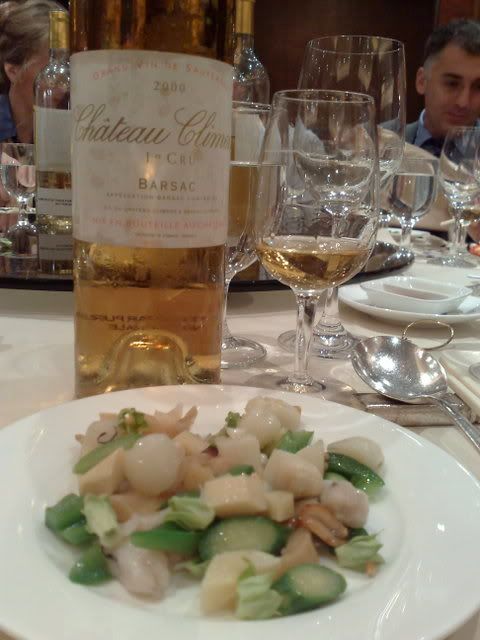
2000 Climens - Paired with Stir-fried Diced Frog. Again, the pairing's balance was slanted towards the wine, i.e., I enjoyed the wine more alone rather than (with) the food. The Climens was somewhat similar to the Suduiraut, but playfully lighter and with crisper acidity; admirable complexity/depth/layering on a much lighter frame, and, generally an all-around happy/livelier feel to it.


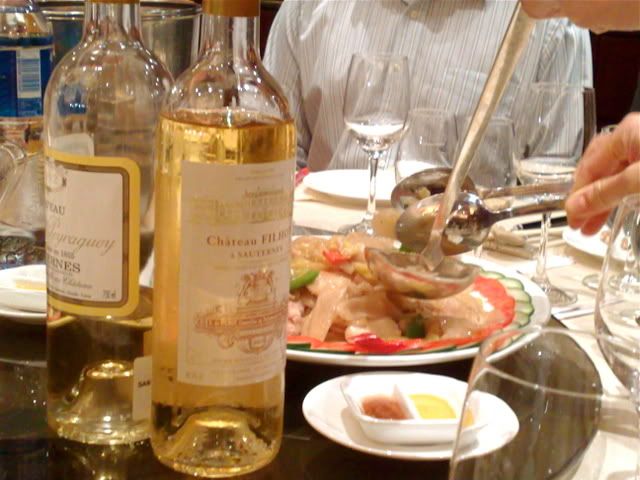
2003 Filhot, 1997 de Myrat and 2001 Suduiraut - With a single, fat, crisp-outside-and-plumply-juicy-inside Deep Fried Oyster.


I believe the next two wines (discussed below) were really meant for this dish and not the 2001 Suduiraut, the latter being too rich and big for the dish. I couldn't help but keep sipping it, though, as I liked it so much.

The 1997 de Myrat's visage of beautifully deep, amber-gold with an orange blush made me expect more body/weight/complexity than it's light-side-of-medium body and dominant bittersweet orange marmalade back-end displayed. Fair enough of a wine (depending on its price), but I couldn't help thinking it didn't live up to its looks.

The 2003 Filhot, on the other hand, was similar to its Barsac compatriot, Climens, in that it had a notably lithe/brighter/livelier feel to its acidic balance with entertaining lychee whispers over caramel and candied orange rind. Cute wine.

Having said that, I couldn't quite get the pairing. Shellfish (moreso deep-fried shellfish) makes my palate yearn for a crisp, dry Sancerre blanc or Pouilly-fumé. My problem, really, but, there it is.

With the the next dish of Smoked Pomfret, I had the 1999 La Tour Blanche and revisited the 2004 Doisy Daëne , together with the Filhot and de Myrat.


1999 La Tour Blanche - This wine struck a precise balance of peachy/ripe mango sweetness and acidity: lithe, agile, bright, discreetly sweet, with comparable weight to the Doisy Daëne but with much better depth, structure and complexity. I think this paired best with the smoked fish.

With the first bite of the somewhat salty/mildly smoky fish, I figured the one who made the pairing had in mind (and was trying to play off) the traditional salty-sweet combination of Sauternes and roquefort. the dish worked well with the three mentioned lighter/brighter wines. This pairing was also a revelation for me.

With the next dish of Wild Geese Resting on Plum Tree, I had, mainly, the 1998 Guiraud, but also tried it with the 1996 Coutet and, again, the 2001 Suduiraut.


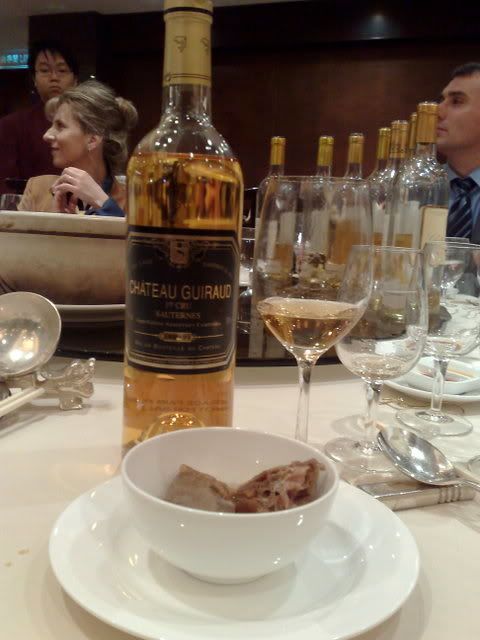
The 1998 Guiraud had structure/weight similar to the 2001 Suduiraut and was expansive (the flavors cloaked and held my palate to great length). It possesses a deep, definitive middle that, together with its aforementioned weight/structure, and its savory orange-rind undertones (beneath its marmalade notes), made it an excellent match with the dish. The 2001 Suduiraut was also an impressive match.

The 1996 Coutet was comparatively lighter on its feet than the Suduiraut and Guiraud, and had a more ethereal/elegant character to it. The Coutet's definitive authority of flavors certainly, though, rivaled that of the Suduiraut and Guiraud despite the former's comparatively lighter frame.

I was not much surprised with the fine pairing of Sauternes with Hong Kong-style goose. Goose in Hong Kong is normally served with its own juices and a side of plum sauce. I think this was lightly roasted, then braised in its own juices with a light touch of plum sauce thrown in. The savory and sweet just tied together sublimely.

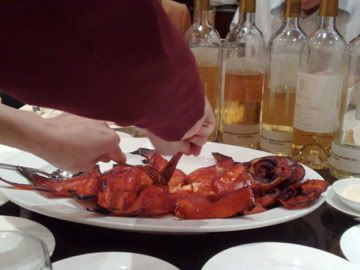
I continued with the 1996 Coutet with the next dish of Pan-fried Prawn in Shell since the prawn was coated with a thick, sweetish-mildly spiced red sauce.


I figured since the prawn wouldn't be able to take the Suduiraut's or Guiraud's size/power and the sauce needed a definitively flavored wine, the Coutet would do nicely. It did indeed (patting myself on the back, I know).

Fried Rice Vermicelli Szechwan Style followed with Sweetened Almond Milk Cream ending the meal nicely, if none too lightly.

We were fortunate enough to be seated at the same table as Suduiraut's Managing Director, Christian Seely, and his lovely wife, Corinne, and were treated by them to a "bonus" bottle of 1988 Suduiraut which I enjoyed by itself as my dessert. Here they are peeking from behind the '88.


My now alcohol-addled scribbles state:

Incredibly long, luscious, full/smooth/permeating, orange rind, then sweet apricot, marmalade, orange liqueur, viscuous, layered, harmonious and precisely balanced.

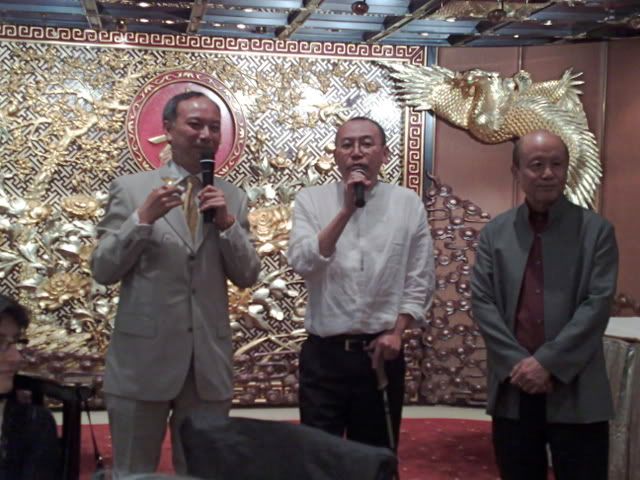
Sometime in the latter part of the evening, the organizers auctioned off a Sauternes necktie autographed by the various châteaux's representatives present (Mr. Kinsen Kam, the Yung Kee Group's owner-Director-General Manager, is on the right). Judy made the opening bid of HK$5000 (approximately US$707) and things escalated after that.


Many thanks to Judy for inviting us to a most enlightening and delicious dinner.

Tuesday, May 13, 2008

Manila Blind Bordeaux Challenge IX

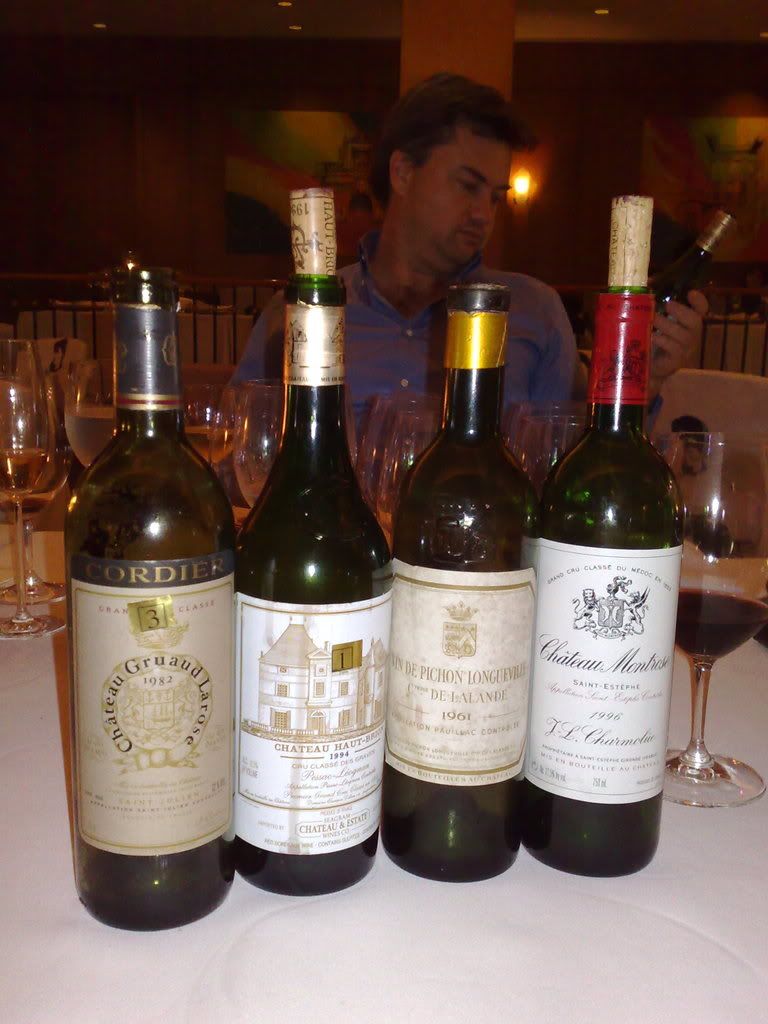
Manila Blind Bordeaux Challenge IX finally took place Friday night, 9 May 2008. The reigning king was the Doc who won the last Challenge with a superb ‘96 Cos d'Estournel. Pressure was on me this time as I was the last one with only one win under my belt (Edouard with 3 wins, the Doc and Stockbroker with 2 each).

Back at the traditional Challenge venue of Old Manila, we started off with Moët & Chandon Rosé NV from the Doc and 1997 Jacquesson Rosé from the Stockbroker. I do like Moët’s rosé NV: a clean, compact, linear, charming and disarmingly simple dry bubbly rosé. The Jacquesson is marginally fuller with more depth to its fruit and a more pronounced middle. Both were most welcome aperitifs, especially after a hot and humid summer’s day.

After appetizers (I had an exceptionally good French onion soup to start), the reds came out. Before all else, I must state that, from the outset, everyone declared this to be the most difficult challenge yet, with all the wines of exceptionally high caliber. With my main course of excellent duck breast and confit:

Wine # 1 – For me, unquestionably the best bouquet of all right off the bat: A seductive, exquisitely perfumed mix that to mind called sweet cherry and raspberry liqueur infused with sweet Spanish cedar. There were mild truffle notes at first which faded to the background after several minutes; otherwise, the bouquet held well over the evening’s span. In the mouth, it was on the slightly heavier side of medium, its cassis base delicately laced with kirsch, sweet tobacco notes, dark spice and traces of dried thyme. Incredible balance.

By bouquet alone, without having even tasted any of the wines, this and Wine # 4 were, to me, the two contenders for best wine. Several passes didn’t change things. I eventually ranked this the best wine of the night.

Wine # 1 turned out to be the Stockbroker’s 1994 Château Haut Brion.

Wines # 2 & 3 – The Doc and I noted that these two broodingly dark wines were somewhat similar. Both, to me, performed like rich, ripe, earthy, masculine, truffled, full-bodied Médocs from the mid-90s. The Doc noted Wine # 3's more apparent tobacco and leather notes and its comparatively fuller body. I felt that Wine # 3 was better knit, had interesting ripe fig notes to it, a marginally better nose and slightly more complex; so I ranked Wine # 3 as the third best of the night and Wine # 2 as the fourth best.

Wine # 2 was the Doc’s 1996 Château Montrose.

Wine # 3 turned out to be my 1982 Château Gruaud Larose, a most generous albeit undeserved gift from NSF, a very good friend.

The Stockbroker, Doc, Edouard, Sevrine and I commented later on how very young the ’82 Gruaud seemed. This has at least 20 years more in it.

Wine # 4 – This to me had the second best bouquet of the night as well as being the best in the mouth. It was also the most visually attractive to me: exceptionally pure and clear, a regal medium red with a red-orange blush. It looked to be an old wine, but I couldn’t guess how old. The Doc noted its medium body and definitively declared it the oldest wine. I loved its mouthfeel: an ethereal pure silk on the palate, a softly truffled elixir of red currants, dark cherry, violets with trace essence of cedar. Stunning wine, it was a textbook in elegance.

Deciding between this and Wine # 1 was a Herculean task at best, but I eventually ranked this wine the second best of the night.

It turned out to be Edouard’s 1961 Château Pichon Lalande. Again, many noted how young and fresh this wine was despite its almost 47 years of age. What a rare treat!

In summary, my own ranking was:

1st Place – Wine # 1, the Stockbroker’s 1994 Château Haut Brion;
2nd Place – Wine # 4, Edouard’s 1961 Château Pichon Lalande;
3rd Place – Wine # 3, my 1982 Château Gruaud Larose; and,
4th Place – Wine # 2, the Doc’s 1996 Château Montrose.

Collective Results:

As usual, Sevrine tallied the scores and announced the night’s ranking. It was a close fight:

1st Place – Wine # 3, my 1982 Château Gruaud Larose with a total of 24 points, including 4 votes for first (my wife’s, the Stockbroker’s, Mrs. Stockbroker’s and the Doc’s).

2nd Place – Wine # 1, the Stockbroker’s 1994 Château Haut Brion with 21 points, including mine and Mrs. Doc’s votes for first.

3rd Place – Wine # 4, Edouard’s 1961 Château Pichon Lalande with 18 points, including his own and Sevrine’s vote for first.

4th Place – Wine # 2, the Doc’s 1996 Château Montrose, separated from Edouard’s score by one, with 17 points.

My wife's votes were matched the collective ranking exactly.

Needless to state, I was more than a little relieved to get my second win in our group’s Blind Bordeaux Challenge. Bravado flooding back, I couldn’t help pointing out that I also currently hold the Blind Non-Bordeaux title so I am now the undisputed champion of the world (as far as our little group is concerned, anyway).


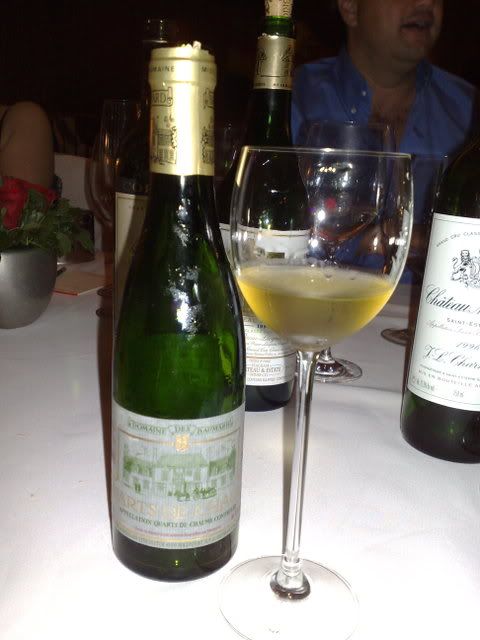
Victory was made even sweeter by the Doc’s 2002 Baumard Quarts de Chaume, a vibrant, minerally wine with dominant honeyed apricot, pineapple and peach primaries, hints of straw, a steely backbone underneath the stone fruit and exceptional balance of sweetness and acidity.

Many thanks to the generous donor of my winning wine, and to Edouard who was the one who selected it for the former as my gift.

Thursday, May 1, 2008

Dinner at CAV: 1 May '08

Dinner at CAV, 1 May '08 with my wife, children and nephew.

Quite dehydrated after 18 holes under the sun, I was in no condition or mood to finish a bottle each of white and red; so I opted to re-try CAV's wine-dispensing machine despite the less than stellar experience the Doc and I had with the '94 Château Margaux a little over a week ago.

With a yellow fin tuna and roast red beet tartar and a side salad:

2002 Jean et Gautier Thévenet "Domaine Emilian Gillet" Viré-Clessé - Firstly, it was not chilled enough. A bit cool, but not enough, and it quickly warmed in the glass. I first tried this wine a little over a year ago with Jérome Philippon when he started importing the wines of this domaine. Needless to state, it was served at proper temperature and I liked it so much more then - bright, pure, almost steely, tense, clean chardonnay flavors with nice minerality and good/refreshing balancing acidity.

In any event, I just had one glass of it this time. The first few sips (while still a bit cool) brightened up the tartar, but, as it warmed, its refreshing/palate-cleansing prowess disappeared. Warm white wine simply doesn't interest me, nor, do I expect, would it interest anyone else.

The dish was good enough if eaten together with a bit of the accompanying salad, the dressing of which brightened up the tartar's somewhat heavy, earthy flavors and the greens giving needed textural contrast.

Fearing the temperature issue, I didn't bother choosing any other white to go with my 2nd course of a good, mildly creamy, cheese tortellini with proscuitto.

With my main course of rib-eye steak:

2000 Tenuta San Guido Sassicaia - I tried half a glass at first as I thought it may be too young to enjoy. I went back for more. This wine I enjoyed; especially with my steak.

General earthy feel to its medium-to-full-somewhat-soft-body. Ripe (almost roasted-ripe), gentle yet adequate fruit - earthy cassis dominates with fleeting, entertaining dark cherry/raspberry notes. It stood up to the steak well, the dark fruit/earthy cassis running with the meat and the dark cherry/raspberry gave a bit of necessary contrast saving the palate from fatigue. I was pleasantly surprised how mature this wine tasted at under 8 years from vintage.

In all, it was adequately pleasant and enjoyable. I wouldn't buy a whole bottle of this, but an occasional glass or two with steak does well enough when one isn't up to finishing a whole bottle of something better.

CAV didn't (or doesn't) offer dessert wine by the glass. Besides, even if they did, it likely wouldn't be held at the proper temperature anyway. My chocolate soufflé, though, didn't really need any vinous accompaniment.

I got upset with the service tonight. The waitress was, in a word, inattentive. Finished plates of the main course were allowed to sit and sit and sit without being cleared. Water glasses were not re-filled. Truth to tell, service only improved when I complained to the manager. I told him that nearby tables of two seemed very well-served while our table of six was not. I also pointed out that all of us, including my children and nephew, ordered full courses so the restaurant was surely making more money off us than any table of two.

Pity, service was excellent last time I was there, but we were seated at a different station at the time.

2005 Siran & "S" de Siran

29 April 2008, at the Benjarong Restaurant of the Dusit Hotel Manila, Edouard brought his 2005 for us to re-try:
2005 Château Siran - I tasted this 2005, among others, in July 2006. My notes then were as follows:

Chateau Siran- Big, chunky black fruit, cassis and some leather over mild black coffee and violet notes. Lots of weight and rolling muscle in this wine. A powerful, tannic bully-boy now. I think this may mirror their '82 now in around 15-20 years. Yet another with great ageing potential from Siran.

Last night, the wine poured a brilliant royal ruby-red darkening to a midnight purple and red core. Very visually attractive. I let the wine breathe for an hour in my glass before sipping.

When the youthful alcohol finally subsided, it released a rich, spicy aroma that called to mind crushed, ripe blood-red wild berries over ripe plum, blackberry compote and minerals, with hints of camphor, Spanish cedar and iron.

In the mouth, the red-berries were pure and rich with a touch of sweetish ripeness, underpinned by cassis, dark plum, touches of dark spice, licorice, with espresso, mocha and pine needle nuances, subdued minerals and earthy whispers of iron and leather.

Evidently less burly than in July 2006, with the royal red berries coming through the black fruit elegantly. A lot of the chunkiness has gone, the wine has smoothed out immensely, though, of course, still youthfully tannic. Full-bodied, well-rounded, powerful with an incredibly long finish. I think the balance of power and grace is quite notable and believe this will be very long-lived. I'm talking many decades.

I no longer think this will grow up to be like their 1982. It seems to me that, given several decades in a cellar, it may evolve more along the lines of Siran's gracefully feminine, ethereal and elegant vintage 1953.

What can I say? I was very impressed. Over-performing in spades.

This is definitely a buy for the cellar.

2005 "S" de Siran - The 2nd wine of the château, from younger vines and without any petit verdot. Visually similar to the 1st wine, but marginally less dark. The flavors likewise similar, but not as big or hefty - it is medium-bodied plus a bit. Comparatively linear, lighter on its feet, with a less heavy dark fruit base and noticeably less iron/leather nuances but more apparent minerality. The red berries are very pure. I can't seem to emphasize purity enough.

After letting it sit in the glass virtually undisturbed for an hour and 15 minutes, the aroma was so sweet with tiny ripe, bright red berries and sweet cedar. Lovely 2nd wine. Probably be drinking well in 2-4 years, but already enjoyable with material aeration.

I understand that limited quantities of these two wines will soon be available at Premium Wine Exchange (and, possibly, elsewhere). Better reserve ahead of time, others were at the dinner last night and it may very likely go fast. The first tranche of the 2004 vintage (also rated in the 90-90+ point range by Wine Spectator, for whatever that may be worth to some) disappeared in a snap. Daniel Rogov, a professional reviewer whose tastes in Bordeaux wines I find jive with mine, rated the 2005 Siran 94 points (higher than many better-known and much higher-priced wines of the vintage such as the venerable Lynch-Bages) with tasting notes (from March/April '08) pretty much similar to mine.

In the market for an exceptional and relatively reasonably-priced wine from the most lionized and sought-after recent vintage to date? One that can age gracefully for at least 40 years and up?

Get some of the 2005 Siran for your cellar and thank me later. You'll be able to toast to your grandchild's college graduation with this.

Friday, April 25, 2008

Je Suis Gourmand's Night of Rhône Cuisine & Wine.

Wednesday, 23 April 2008, Je Suis Gourmand's Wines & Cuisine of the Rhône.

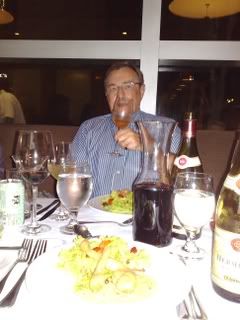
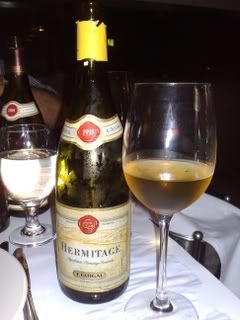
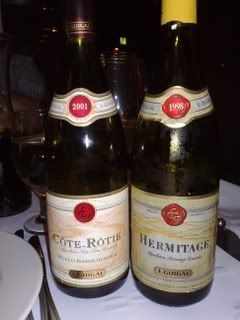
Robert Burroughes, myself and our wives, one table, 6 courses and a few wines. Though we brought a Guigal each (Robert a '98 Hermitage Blanc, and I, a '01 Côte Rôtie Brune et Blonde) Robert, nontheless, opted to order the matching wine set with dinner and let us taste. At a certain point, Jérome Philippon, who was supplying the set pairing, started sending us glasses of his wines.

With Fried Frogs' Legs with Salad and Garlic Cream (precisely executed, not oily or greasy at all, a bit of crunch outside while perfectly moist and juicy inside, very clean, fresh flavors):


1998 E. Guigal Hermitage Blanc - After warming down a bit, this medium yellow-gold wine had generous breadth mid-palate that funneled down smoothly to the finish with beurre noisette/toasty nuttiness spearing mineral, honeysuckle and vanlilla laced, mildly-spiced fleshy/stoney fruit. We noted an ever so slight whisper of oxidation, but not enough to be bothersome.

2005 Domaine des Entrefaux Crozes Hermitage Blanc - Light, bright lemon yellow, a bit tight, lightly floral in the nose. On the palate, fresh, minerally, pure, clean, lean, precise, almost steely fruit. I suspect this will flesh out and expand mid-mouth with time in the glass. Nice to compare and contrast one with the other.

As regards the pairing, I preferred the Guigal Hermitage Blanc with the frogs' legs, but posit the Entrefaux Crozes Hermitage Blanc a better match with the 2nd Course of Steamed Rainbow Trout Fillet with Vegetables and White Wine. The Hermitage Blanc was a bit too big for the fish.

The 3rd Course was a rustic, earthy and comforting Mushroom & Bone Marrow Pot-au-feu which I had without wine.

After a palate-resuscitating Red Wine & Red Currant Sherbet, the 4th Course of Roasted Venison Rack with Galette Lyonnaise & Roasted Onion was served. This was my wife's favorite dish of the evening. Having finished every bit of my previous courses, I was already getting full and felt a bit guilty when Marc noted that I didn't quite finish off my rack while everyone else's plates lay bereft of food.

With the tender and juicy venison:

2001 E. Guigal Côte Rôtie Brune et Blonde - I must say that I appreciated this properly refined, medium-bodied Rhône (none-too-alcoholic unlike many other modern Rhônes), such as it was: laced lightly with dried/roasted herbs/pepper; red berry-dominated (red currant (or was that the sherbet haunting my palate?)/raspberry/hint of strawberry, mild tobacco and dark spice, woodiness and just a dash of pepper. Very mild earthiness. Finely and delicately layered. If there is any criticism I can make, it would be that the middle is a bit weak. But that's about it.

2004 Domaine La Roubine Gigondas - An evidently riper, bigger-boned, more extracted wine with a well-rounded middle and lusher over-all feel to it - more immediately pleasing, seemingly designed to entertain - the type meant to stand out in blind tastings. This had comparatively more dark fruit/casis underlying the cherry and raspberry, with a permeating slight gaminess and attendant notes of cacao, black coffee and oak/vanilla.

A mental comparison to the 2001 E. Guigal Gigondas made me think that this wine is cut from a more modern cloth - smoother, sleeker, less rustic.

Be it as it may, I honestly think the 2004 Domaine La Roubine Gigondas paired better with the venison. Due to the Brune et Blonde's somewhat weak middle and medium-body, it somehow got lost in the venison and sauce, though its dominant red berry notes did indeed brighten up the earthy dish.

Note: this was supposed to pair with the pot-au-feu, but I had it with the venison. I imagine it would have over-powered the pot-au-feu.

With the Bleu de Bresse Salad Course:

2005 Domaine Chèze Ro Ree Rhône Nord St. Joseph - Rustic, earthy, peppery, spicy, brambly-raspberry-and-red-cherry-dominant somewhat smokey wine. Medium bodied, lighter-boned than the above-mentioned Gigondas. Pleasant, if not particularly distinctive.

With the Dessert Course of Blackberry Clafoutis Tart with Sauce:

2005 Jurançon Clos Lapeyre - Straightforward, tartly sweet lemon/citrus, bright and light on its feet. Healthy, bracing acidity. It was like drinking a glass of a liquid version of the tart citron served at Alliance Française de Manille. Sans the crust, of course.

Tuesday, April 22, 2008

Some Wines: 11-21 April 2008, Mostly Burgs and a '66 Palmer

Lunch of April 11 at Aubergine:

1997 Jadot Morey St Denis - with Robert Burroughes and Lawrie Martin, after yet another well-chilled bottle of '99 H.Bourgeois Sancerre "La Bourgeoise" (can't seem to get enough of the stuff lately) with a bowl of excellent prawn bisque. I've posted on the '97 Jadot Morey St Denis late last February and those old notes state:


The cork was absolutely pristine and the wine immediately offered up a seductive bouquet perfumed with violets and the slightest hint of vanilla cream. Wide open and generous, ripe dark cherry and raspberriy layers dominated the palate with, again, slight undertones of violets, and, some plumminess underneath, all on a lushly curved medium body.

This wine had a feminine touch and delicacy to it, unlike the earthier, masculine Dujacs previously mentioned. Focus could have been much better and the flavors did display some separation towards the back. Length was adequate at best. Still and all, it was a very enjoyable bottle, and, at around the equivalent of $55 for an immediately available Morey St-Denis fix, I cannot reasonably complain. On the contrary, I am going back for more.
What I can clarify is that, though feminine compared to the Dujac's Morey St of the same year, this wine still maintains the fuller, earthy, somewhat rustic charcter of Morey St Denis. Smooth but not, say, truly refined, neither ethereal nor "aristocratic" (for lack of a better word) - which I do not look for in Morey St Denis anyway. Still, very enjoyable with my seared magret. Purchased at Bacchus Int'l at around P2600 before discount.

Dinner, 18th April, again at Aubergine: a 1999 Jadot Chambolle-Musigny and a 1966 Château Palmer.

1999 Jadot Chambolle-Musigny - After a generous, well-rounded, oaky, typical '04 Saintsbury "Brown Ranch" Carneros Chardonnay with the first two courses (from Premium Wine exchange at around Php2800 before discount - my wife really likes this stuff so I most always have some on hand). This unassuming village Chambolle-Musigny had definite charm in its supple, lithe mid-medium-body. Cherry, strawberry, some wild red berries dominate with very subtle dark plum and dark berry undertones and mild brown spice notes. Decent length to its finish, moderate complexity.

What struck me most about this wine was how flavorsome it could be on such a proportionately light frame. Much smaller-boned than the above-mentioned Morey St Denis, less emphasis on the middle, more of a consistent performance from attack to finish and very noticeably more refined in over-all character.

Purchased at the Bacchus Int'l at around Php3200 before discount, I think it is a good deal for an immediately available Chambolle-Musigny and would definitely buy again.

I had it with an, unfortunately, less-than-stellar stuffed quail main course. Be it as it may, the Chambolle-Musigny was a fair match for the quail but would be too delicate for a roast pigeon or even duck I'd expect. I, personally, favor Morey St Denis with pigeon.


1966 Château Palmer - This bottle was brought by Mike T. I don't get to see much of him or Anne or the rest of this group these days, maybe a 2-3 times a year at most, but it is always most enjoyable when I do. After successive daughters, they finally have a son, hence, I expect, this special occasion bottle - one from his birthyear, a gift from his younger brother.

Not decanted, I had it opened and let it stand until our main courses were all served. The cork was intact, not crumbly or brittle, though a bit wet. Occasional sniffs from the bottle confirmed it to be fine. It smelled as it should, no off odors at all, even immediately after opening, so I did not decant lest its bouquet tragically dissipate.

Once poured, it was easy to tell it was an old wine - clear, medium-dark brick-red, gradually turning more red-orange towards the rim, with tinge of mahogany. As I've said before, with old wines (say 30 years and up), individual flavors have melded and fused so much that I find it terribly difficult to breakdown the flavors on the palate. But, as always, I will give it a shot.

Its bouquet was a properly reserved (i.e., as opposed to overly showy or mindlessly obvious) perfume of sweet, old violets, cream, some rose, over discreet dark fruit and a hint of cherry. Medium bodied aspiring to full; texturally, a fine, light silken elixir of pure dark cherry essence over discreetly earthy cassis, violets, mere whispers of dark spice. Pure elegance, complex, contemplative and seductive. This is the kind of wine that doesn't attempt to bowl one over with buxom curves; rather, it beckons, with a hint of its charms, the taster to delve deeper - to explore and further discover its exquisite favors.

Excellent wine.

Last night (April 21) at CAV with the Doc, Edouard, Miguel and our wives: 2001 Jadot Corton Charlemagne Grand Cru and 1996 Jadot Chambertin Clos de Bèze Grand Cru.

CAV is a restaurant and wine bar that has undoubtedly the most customer-friendly wine prices in Metro Manila with mark-ups at a fraction of retail cost (approximately 30%-40%) - as compared to the usual 200% to 300% of most all other restaurants. Aside from an impressive enough cellar with many marquee names from Tuscany, Bordeaux and california, it also has one of those new-fangled machines that dispenses wines by the glass and, by the use of some gas injected automatically in each bottle after each pour, is claimed to keep wines from oxidizing for several days. Its kitchen is overseen by Marcus, who has run many of my most favored restaurants in the past, and the food is good and very reasonably priced.

2001 Jadot Corton Charlemagne Grand Cru - My bottle, purchased at Bacchus Int'l at Php6100 before discount. Initially austere/tight aromas/flavors of white minerals, toasty oak, clean/fresh not-quite-ripe apple/honeydew and a whisper of vanilla-like lees opened up and broadened (comparatively much more on the palate than in the nose) as the wine warmed down (I had it placed in a bucket of ice-water and mingled with some people a bit too long).

It was a right proper Corton Charlemagne to me, unlike those from hotter or more famous recent vintages. Firm yet gentle, the fruit took more of a somewhat baked/creamy nuance as the wine broadened in glass, the toasty oak and leesy notes stepping to the background. Decent length, its leesy notes trailing behind the mellow fruit. Over-all, it is a nice, competent Corton Charlemagne, one that will, in my opinion, probably improve over the next 2-3 years.

A quick look at http://www.wine-searcher.com shows this to go for US$104 in Ithaca, NY. Considering 1-2 day delivery costs and air-freight to the Philippines, the resulting price difference between importing and buying locally becomes pretty negligible. If one likes Corton Charlemagne, this will do very nicely.

1996 Jadot Chambertin Clos de Bèze Grand Cru – The Doc’s bottle. Lots of finesse in this medium-bordering-on-full-bodied wine. There seemed to be comparatively more dark/black fruit/berry/plum than red (cherry, red currant, raspberry), as well as notes of kirsch, the faintest hint of cola, and dark spice to this dark, warming wine. Unquestionably (but not unexpectedly) more heft, breadth and complexity than the aforementioned village Chambolle-Musigny and Morey St Denis – good as they were.

It may be a bit of a stretch, but it was something like a more muscular combination of the two, more masculine and earthy than the Chambolle-Musigny yet lighter on its feet than the Morey St Denis and (like the Chambolle-Musigny) seemingly more generous in flavor than one would expect from its aspiring-to-full body. Very nice, indeed.

I had it with a seared magret de canard over risotto topped with a whorl of crispy, ultra thin strands of fried potatoes. I must mention that the crisp of the potato whorl gave this somewhat ubiquitous dish a great contrast in texture and, perforce, made it memorable. Nice touch.

We couldn't leave without trying out the wine-dispensing machine, so the Doc and I shelled out around Php2800 (approximately US$70) each for half a glass each of the 1994 Château Margaux after dinner. Edouard kept trying to dissuade us saying it would not be worth the price, but we didn't listen. I, personally, wanted to compare it to the '94 Angelus and '94 La Mission Haut Brion the Doc and I recently had.

While I do not think it fair to evaluate a wine from a dispensing machine (no matter how good the machine is claimed to be), for what it may be worth, I will factually describe it as: a wine with interesting dark spicy notes to its cedar and camphor laced nose; barely full-bodied, the fruit seems a bit unripe, tannins a bit green, fruit a tad too unripe, good minerality, hints of violets, clean feel. Aside from the somewhat drying tannins, I detected a disturbing, kind of metallic nuance to the wine as a whole.

We were far from impressed. The Doc thought the wine was a bit oxidized. Edouard couldn't help but say "I told you so". Not having had this wine from a full, fresh bottle, I will reserve final judgment until I do - if that ever happens. Admittedly, this experience makes me reluctant to buy this wine. Finding out if it was really the wine or the machine hardly seems worth the US$300+ and up for a bottle.

Sunday, April 13, 2008

'94 La Mission Haut Brion

Dinner last night at Je Suis Gourmand was with my wife, my children, sis-in-law, the Doc and Mrs. Doc.

After a well-chilled bottle of the Doc's Cerdon de Bugey Caveau de Mont St. July (perfect for a summer aperitif), we proceeded to appetizers of cheese/onion tart, terrine of foie gras, roasted bone marrow and escargot bourgignonne with a bottle of my '97 Béyer Tokay Pinot Gris Comtes d'Eguisheim.

The night's highlight, though, was clearly the red, the Doc had a bottle of '94 La Mission Haut Brion breathing in a decanter when we arrived. Good thing he did too as I had mistakenly taken along a bottle of '01 Jadot Corton Charlemagne instead of the '99 Jadot Chambolle-Musigny I had really intended (I was rushing out and grabbed the wrong bottle, they look so much alike and were beside each other). We would have been without a red last night had the Doc not taken a vinous pre-emptive strike.

With our main courses:

1994 Château La Mission Haut Brion - darkly reflective deep ruby-red, the Doc asked me to guess what it was. I sniffed deeply in the decanter and in glass: mildly truffled, touches of dried herbs and sweet cedar to its dark cherry/raspberry-laced cassis and dark fruit. Before I could hazard a guess, he showed me the bottle. That was when I decided on a crispy goose leg confit for my main course. In the mouth, the wine had an elegantly lithe, silken medium-body that mirrored its nose with subtle "tarry" undertones and perfect acidity which lent it precise balance. The finish had adequate length.

I thought it was elegant, the fruit was clean, pure and honest, not over-ripe/sweet/pruney or obvious like many these days. I know it sounds trite, but this was truly classic Bordeaux - properly reserved, yet not at all stingy with its charms. Along with Angelus, this is one of the best '94s from Bordeaux I have ever had.

The Doc mentioned to me that Parker gave it a "91". I'm not surprised I liked it so much then. I've mentioned before that, when it comes to Médoc wines, my personal RP "sweet spot" seems to be in the rough range of "87-92". Wines he rates above that, I usually find a tad low on acid and obvious - lacking mystery.

I must mention that the wine was an absolutely wonderful pairing with my goose leg confit. I initially was caught between that and beef cheeks or maybe rack of lamb. The reason why I eventually chose the confit was because I figured the red wine sauce of the beef cheeks and the lamb would draw the spotlight away from the wine, while a simple, hearty, no-sauce confit would graciously allow the wine center-stage for the evening.

I figured correctly, the crisp skin and soft flesh's mild flavors allowed the wine to shine, playing with the savory , earthy cassis/herbs/tar, and the sweetish cherry/red berry notes adding enjoyable contrast and interplay. Memorable meal.

Wednesday, April 9, 2008

Wednesday Lunch: 9 April 2008

Lunch today (Wednesday, 9 April 2008) was back at the Tivoli. Just the Stockbroker and I this time, as the Doc was busy and Edouard is in Bordeaux attending to the April en primeur tasting of Siran.

With appetizers of, among others, salmon sashimi, smoked salmon, fresh oysters on the half-shell, bite-sized crab cakes and paper-thin slices of assorted Italian ham, a bottle of my 1999 Henri Bourgeois Sancerre "La Borgeoise". I also brought along a 2001 Corton Charlemagne by Jadot and a 1997 Tokay Pinot Gris Comtes d'Eguisheim by Léon Beyer, but I decided to go with the Sancerre since I knew the Stockbroker favors the oysters and, in my opinion, the Sancerre would be the best match of what I brought.


Consistent with my previous, recent notes:

Quote:
A fuller, richer kind of Sancerre (sauvignon blanc) from one of the area's top producers. The "La Bourgeoise" is, I understand, one of their better bottlings which, atypically for Sancerre blanc, is better aged for several years before consumption.

Those looking for an ultra-fresh, grassy, gooseberry/grapefruit forward sauvignon blanc had better stick to Marlborough, New Zealand SBs as this is a different animal. Sancerres, though also crisp, refreshing and palate-cleansing, are more understated, refined and have a subtle, though unmistakable, white minerality to them. I look to them to pair with more delicate seafood dishes...


I can add that this bottle poured a deeper, more luxurious looking golden wine with nuances of ripe guava, admirable balance, refreshing crispness and bracing minerality. These deftly and definitively cut the salmon's natural fattiness, brightened the mini crab cakes and ran with the oysters' sea-freshness.

To go with my main course of rare tenderloin and the Stockbroker's Chilean sea bass, his bottle of 1996 Grand Cru Romanée St. Vivant by Hudelot-Noellat.


We didn't decant it, choosing to leave it open and let breathe in our glasses as we had our appetizers. Right off the bat, it displayed a wonderful bouquet of Burgundy-decay-laced violets/earthy dark red cherry/beetroot with slight craisin (mid-palate) and strawberry (more to the back and finish) nuances; all of which were mirrored in the mouth in a silky, medium-full body.

Intricately layered and complex, a wonderful middle where so much interplay was going on, I held each sip in my mouth longer than politely possible before slowly swallowing. Sucking in some air at mid-mouth released more nostalgic violets and decay. Long earthy beetroot/red berry/strawberry finish.

From first sniff to the last, whistful note of strawberry, one word kept coming to mind: terroir. Nowhere else on earth produces a wine like this.

Friday, March 28, 2008

A Recommended Cab Sauv/Merlot/Syrah Blend from Italy: 2001 Guado al Tasso by Antinori

Having enjoyed Antinori's 2001 Tenute Marchesi CCR, 2001 Badia a Passignano and 2001 Tignanello several times, I picked up a bottle of the 2001 Guado al Tasso a little over a week ago from the Bacchus Int'l, Shangri-La shop just to try and opened it this past Monday. I understand it is a blend of 60% cabernet sauvignon, 20% merlot and 20% syrah (though I didn't know that at the time, thinking it was another sangiovese bottling).

In accordance with an Italian wine-loving friend's advice, I decanted it and let it breathe for around 2 hours before serving it, though I did take a little bit in the glass after 30 minutes just to see how it was. Initially, the aromas were (unsurprisingly) wrapped in youthful alcohol with nuances of pepper, pine, cedar and camphor. The agressive alcohol interfered with my tasting so I set it aside and waited until the 2 hours were up.

Thereafter, the alcohol had greatly subsided, allowing me to enjoy its plump, nicely-rounded, chewy, full-bodied, highly extracted, low-ish acid, sweet, ripe kirsch/cassis/raspberry-dominated primaries and unabashed notes of licorice, toffee, espresso and mild toasty oak/vanilla. I don't recall detecting in the mouth the pepper nuance in the nose.

Not having had much experience with Italian cab/merlot/syrah blends, if this was served blind to me, I surely would have guessed it to be a young Napa cab blend from a better than average year.

Nice, interesting, I wouldn't mind having it with a good, grilled rib-eye, but I honestly prefer the first-mentioned sangiovese-based wines of Antinori.

Still and all, at the price I got it for (around Php4500) I think it is an acceptable deal and would recommend this wine to those fond of Super Tuscans and predominantly cabernet sauvignon-based Napa reds.