

 Posts
Posts


I came across some more notable old write-ups from before I started my blog. Here is one of them.
19th June 2007, I was at Château Léoville Poyferré with (and courtesy of) Franck and Francoise Alby for the Vignobles & Signatures Dinner/Tasting of Le Club des Grands Domaines.
Coming from tasting at Vinexpo that day (10:30am - 2:30pm), I was able to taste through probably only half of the wines. That and because of the cocktail set-up, I was meeting so many people, all of whom, including our evening's host, Didier Cuvelier, found it very curious that a Filipino lawyer with absolutely no business interests in the wine industry came all the way to Bordeaux for Vinexpo.
The Wines Tasted:
Drappier Champagne:
Champagne Carte d'Or Brut NV and Grande Sendrée 2000 with seared foie gras atop apple compote en croute. The Carte d'Or was quaffable and refreshing enough with its moderately bright, focused, linear Fuji apple-dominated flavors with ubiquitous yeast/white flower profiles. This simple, light champagne would be something for the beach, I imagine. The Grande Sendrée, as to be expected, had much more character, nicer body and a touch of complexity to it. Good enough, I suppose for moderately-priced champagne. Honestly, though, I do not see myself buying either of these bubblies.
From Jean Durup Père & Fils (Chablis):
2005 Chablis 1er Cru Fourchaume, Château de Maligny and 2005 Chablis 1er Cru "l'Homme Mort", Château de Maligny. Both were relatively simple Chablis: the Fourchaume light, feminine, a bit thin and lacking in personality; the l'Homme Mort (or "the dead man", such a very curious name) masculine with more minerality and an obviously better middle. Both displayed, at the time, very dominant lemon notes - a bit too much for my taste.
Domaine Antonin Guyon (Burgundy):
2005 Meursault Charmes 1er Cru Les Charmes Dessus - More than decent minerality, citrus fruit and heft in the middle (specially compared with the 2 preceding wines). Good enough. Should be better in around 5 years, I think.
2005 Chambolle Musigny Clos du Village - Simple, up-front, sweetish cherry/beetroot/strawberry flavors, at virtually the lightest spectrum of medium-bodiedness. Nothing complex, but quite pleasant nonetheless.
2005 Corton Bressandes Grand Cru - A natural medium body, less sweet than the Chambolle Musigny, nicer weight, deeper flavors, comparatively more complex, more masculine. More than decent wine.
Les Vins Louis Tête (Beaujolais):
2006 Beaujolais Blanc - This was the very first white Beaujolais I have ever had. A fresh, fruity, pleasant white. Very quaffable, a vision of a nice, simply cooked tuna dish sprang to mind. Not being familiar with this region, moreso with the whites thereof, I commented to the nice young fellow doing the pouring that it reminded me of a light Meursault. He seemed quite happy I said that, and made sure to point out that I could not buy a bottle of decent Meursault at his price of 5-6 Euros. He was right of course.
2006 Côte de Brouilly Rouge La Chapelle - It smelled like berry-infused rosewater. It's light-to-medium body was comparatively generous with dark berry/strawberry/slight raspberry flavors and alluring violet notes in the middle and to the finish. Would definitely qualify as a good red for summer.
Château de Tracy (Loire):
2004 Pouilly Fumé - Quaffable, bright, refreshing, unmistakeably sauvignon blanc with decent minerality. Decent enough, good for summers at the beach.
2005 Pouilly Fumé - Rounder and fuller than the 2004 version. Nice and bright, more gooseberry than grapefruit, almost equal in dominance to the lemon/citrus flavors. Not bad at all at its 8.50 Euros per bottle price*.
2005 Pouilly Fumé "Mademoiselle de T" - This is their 2nd wine. Its nose was quite similar to a sauvignon blanc from Marlborough, New Zealand in that the fresh, bright grapefruit and gooseberry notes were relatively aggressive and grassy (Franck and I noticed this almost immediately but kept our conversation to a mere whisper lest we offend), though not enough to be over-bearing. Around 5.70 Euro per bottle*.
2004 Pouilly Fumé "HD, Haute Densité" - A well-made, pleasantly dry Pouilly Fumé with noticeably more character, concentration and minerality than the other bottlings; grapefruit-dominated with nicely woven lemon/citrus notes. Around 24 Euro per bottle*.
*Franck got the prices from Comte Henri d'Estutt d'Assay who was pouring for us. He seems like a very committed man, passionate about his wines.
We then moved indoors for dinner. A band was playing. It was quite a relaxed and festive atmosphere. I spent much of my time with Franck, Francoise and their long-time friend, the most charming Vincent-Noël Martelly (Didier Cuvelier's brother-in-law, if I am not mistaken). I was quite surprised that he switched to speaking in Spanish when he found out I was from the Philippines - I didn't expect many Frenchmen knew that our country was under Spanish rule for around 300 years.
Dinner continued stand-up, cocktail style with excellent dishes of roast duck, foie gras, etc. being passed around in small dishes. For seconds, one had to line up at the long tables, which was not a problem at all since Francoise is an absolute magician at appearing suddenly at the top of the line each time we wanted more. She could just walk straight up to the top and nobody seemed to mind at all. I bet I would have been assaulted if I tried doing that.
With dinner, I pretty much stuck to the 1999 Léoville Poyferré (Magnums) - Unquestionably the best wine that passed my lips during the affair, but then I became an avid fan ever since the Doc brought a bottle of the '96 vintage to one of my dinners. The '99 was marginally less rich and generous with its flavors and aromas (then, again, it is younger) than the '96, but otherwise cut from the same cloth with subtler earthy, truffle notes and a more approachable over-all feel to it. Very impressive given the vintage. At a mere US$42, this is a definite buy for me.
While having the duck course, Franck urged me to try the magnums of CdP being offered: 2000 Château de la Gardine CdP "Cuvée des Générations Gaston Philippe" - This is one of those darker, bigger, dense, richer CdPs unlike the more understated, lighter-bodied, ethereal ones I remember drinking from my father's bottles during the mid 80s (I understand CdP was quite the rage in Manila at the time). This had a pleasantly warm, earthy feel to it with a touch of gaminess that played nicely with the magret. Quite enjoyable indeed.
After dessert, dessert wine and espresso, I developed a bad case of hiccups which prompted me to excuse myself. I went out to the balcony over-looking the winery across the driveway where some people were milling about. Apparently, my case was worse than I realized, one particularly violent hiccup startled the people downstairs. How embarrassing.
Friday, July 4, 2008


Tuesday, July 1, 2008
1996 First Growth (1855 Classification) Dinner.
I recall it was over dinner at Sala in early June (Doc and I were home alone as my wife and kids were in HK while his were in Germany), when the Stockbroker and Doc decided we organize a 1996 top growths (1855 Classification) dinner for the 29th June.
 I told them it would be all up to them as I didn't have any on hand and wouldn't have time to import any and have them rest properly (as a general rule, I let bottles rest for a month after being flown in so they may "re-stabilize").
The Stockbroker took the lead in organizing this event, and, later on, informed me that, for our dinner for 7 persons, the final line-up of reds would be as follows:

I was to provide the champagne to start which was to be a couple of bottles of 1996 Veuve Clicquot "La Grande Dame", and, the Stockbroker, a half bottle of 1996 Yquem for dessert. As it turned out, Gentleman Joe also brought a '96 Dom Pérignon which we could compare with the La Grande Dame, as well as a '01 Rieussec to stand beside the Yquem. The pairing dinner menu was meticulously prepared and executed by Tippi Tambunting.
With pass-arounds of Sautéed Scallops with Braised Oxtail and Microgreens, and, Beignet de Brandade with Tomato Confit:
Wine #2 - Wine D, Lafite Rothschild (JR 18.5, RP 100)
Wine #3 - Wine E, Margaux (JR 17.5, RP 99)
 At the beginning of dinner proper, I made it clear that, as far as I was concerned, ranking this group of wines was an exercise in debating degrees of excellence, and, reiterated after votes were cast that all were quite wonderful in their own ways.
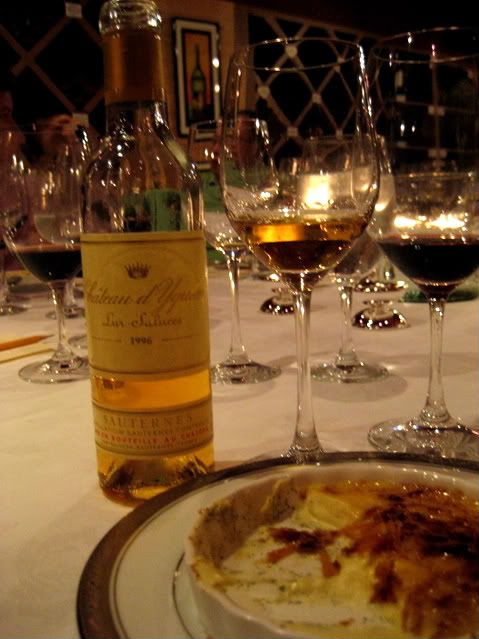
The aftermath was just as wonderful. We enjoyed the Stockbroker's Yquem and Gentleman Joe's Rieussec with a simple Vanilla Bean Crème Brûlée with Candied Orange Zest. At that point, I was a bit mentally exhausted from analyzing the reds so I shamefully neglected to write down any notes on these vintages of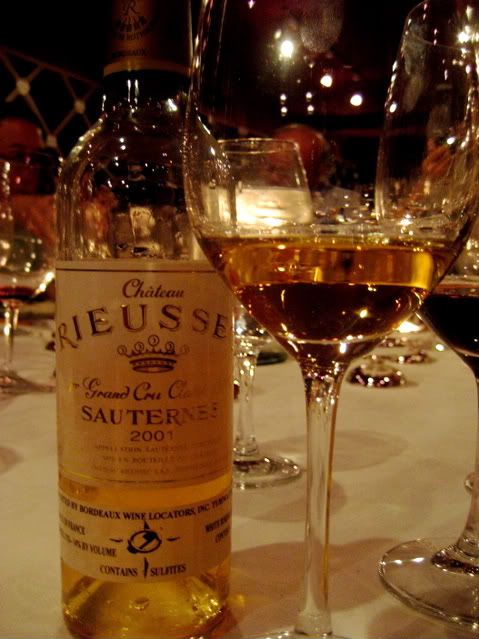 the King and Crown Prince of Sauternes. You'll just have to take my word for it that they were both sublime.
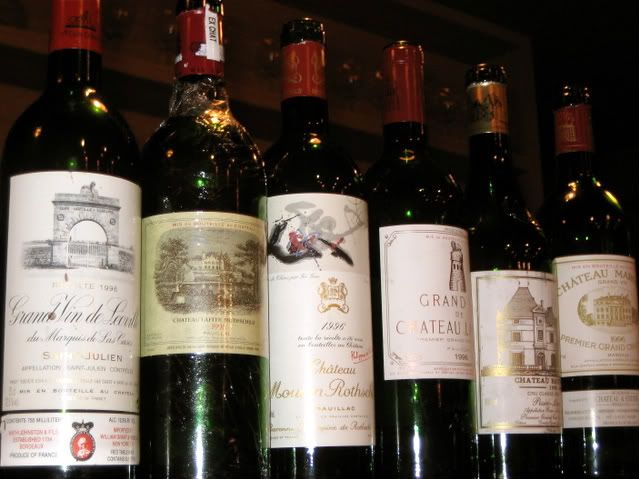
I told them it would be all up to them as I didn't have any on hand and wouldn't have time to import any and have them rest properly (as a general rule, I let bottles rest for a month after being flown in so they may "re-stabilize").The Stockbroker took the lead in organizing this event, and, later on, informed me that, for our dinner for 7 persons, the final line-up of reds would be as follows:
- 1996 Haut-Brion - from Eric R.
- 1996 Lafite Rothschild - from Uncle David
- 1996 Latour - from the Doc
- 1996 Léoville las Cases - from Gentleman Joe
- 1996 Margaux - from Dapper D.
- 1996 Mouton Rothschild - from the Stockbroker
I was to provide the champagne to start which was to be a couple of bottles of 1996 Veuve Clicquot "La Grande Dame", and, the Stockbroker, a half bottle of 1996 Yquem for dessert. As it turned out, Gentleman Joe also brought a '96 Dom Pérignon which we could compare with the La Grande Dame, as well as a '01 Rieussec to stand beside the Yquem. The pairing dinner menu was meticulously prepared and executed by Tippi Tambunting.
With pass-arounds of Sautéed Scallops with Braised Oxtail and Microgreens, and, Beignet de Brandade with Tomato Confit:
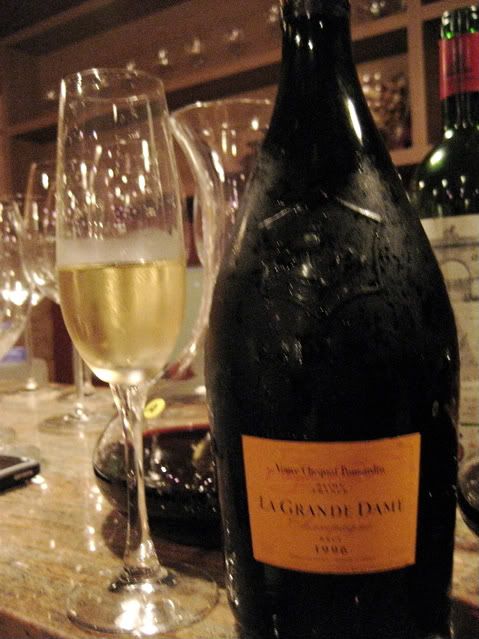 1996 Veuve Clicquot "La Grande Dame" - I think this is the first time I tried this vintage of La Grande Dame as, to the best of my (ailing) memory, I recall having had only the '89, '90 and '95. Clean, pure white fruit attack turns floral, very toasty and mildly yeasty the moment it hits mid-palate, where it expands generously and gains substantial creaminess towards the back. Sucking in a bit of air once the bubbles allow emphasizes the toastiness. This bubbly certainly wasn't shy; it was eager to please, displayed proudly mid-mouth with a funneling exit of added citrus notes.
1996 Dom Pérignon - We've had this many times and I've written at least 2 tasting notes since early 2005 when I first tried it, the last written notes I've found being from early December 2006:
Dom Perignon 1996 - A gift to me by the Doc, I brought it to go with the
starters. We've gone through many, many bottles of this over the last couple
of years, and it remains as bright and linear as ever. My old notes state:Toasty young citrus with easily detectable yeasty/bread dough notes
trailing. Bracing, bright, crisp, linear, firm yet enthusiastic primary
flavors of pineapple, apricot and lemon. Acids pronounced in the finish.
Still quite young, a long way to go, very precocious but charmingly
so.I add now that the apricot is very faint and the wine is noticeably toastier
than before. A very good Dom Pérignon.
 What I can further add is that, in comparison to the Grande Dame (though most enjoyable and entertaining in itself), the Dom has obviously better focus, much finer mousse, a tighter-knit body (beside the Grande Dame, the latter seems slightly loose and scattered), purer fruit and a healthier, bracing acidic edge.
In all, I say the Dom was a neater, finer, more complete and streamlined package. At this stage, I'd open the Grande Dame for joyous frivolity and the Dom for more refined occasions and contemplative moments.
We were finally seated and dinner proper began with Essence of Pot-au-Feu Bone Marrow, followed with a salad of Mixed Greens, Reblochon, Toasted Walnuts and Truffle Vinaigrette. I didn't have any of the reds yet as I rarely have reds (or whites for that matter) with soup courses and actively avoid mixing reds with any type of vinaigrette. A tip of the hat to the chef, however, for serving a somewhat "lighter" yet full-flavored comfort soup, and incorporating reblochon and walnuts into the salad (both of which are usually served with cheese platters in Bordeaux). Needless to state, the hint of truffle in the dressing was, most likely, designed to run with any earthy/mushroom notes of the Pauillacs.
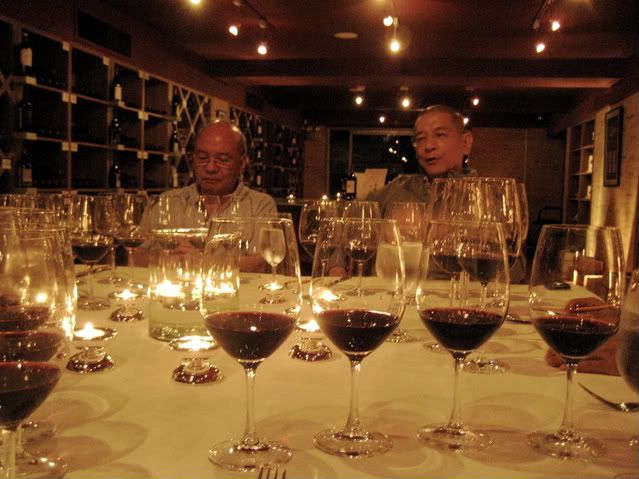 Next was a dish of Portobello and Goat Cheese Ravioli in Sage Butter with Parmesan Cheese. This dish was a study in meticulous pairing as portobellos, sage and parmesan cheese are well-known to be red wine complementary. Though, personally, I like goat cheese with Pouilly-Fumé or Sancerre blanc, it is served with reds in Bordeaux; and, with a particularly gamey red, it is a "run-with-the-ball" type of pairing.
I skipped the Dalandan Sorbet to preserve my palate for the reds...and what reds they were.
With a main course of Roasted Prime Rib-Eye Au Jus, Potato Lyonnaise, Dwarf Bok Choi, the wines were served and ranked semi-blind (i.e., we knew what the wines in the line-up were but were not told which was which):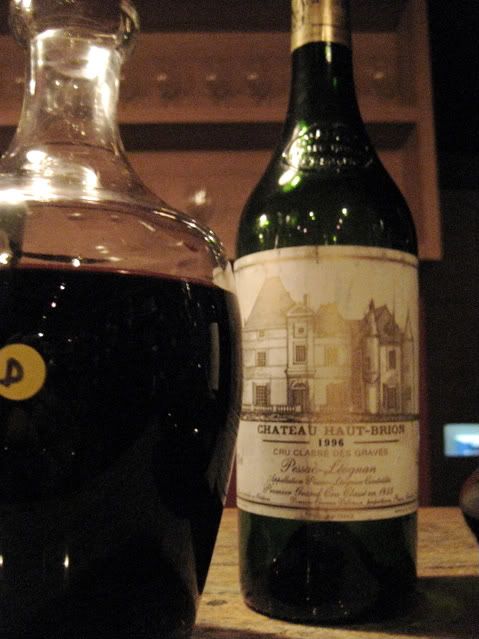 Wine A - I immediately noted readily apparent roasted herbs in the nose and Gentleman Joe pointed out the slight scent of chocolate (Eric said mocha while I leaned more towards milk chocolate). Sweet cedar, touch of camphor, mild gravel infused the dark fruit/cassis. Ripe cherry/mild raspberry highlights. Long finish, warm and comforting feel.
The only 1855 first growth not from the Médoc was Haut-Brion, from Graves (since 1987, over 20 years ago, 10 communes in Graves were "lumped into" a more prestigious appellation called Pessac-Léognan). Wines from this area normally have roasted herbs touches and gravel/"tar" notes to the cassis/dark fruit base beneath red fruit. The herbs and gravel gave this one away, most likely. I and others guessed it to be the Haut-Brion.
It turned out, in fact, to be the 1996 Haut-Brion.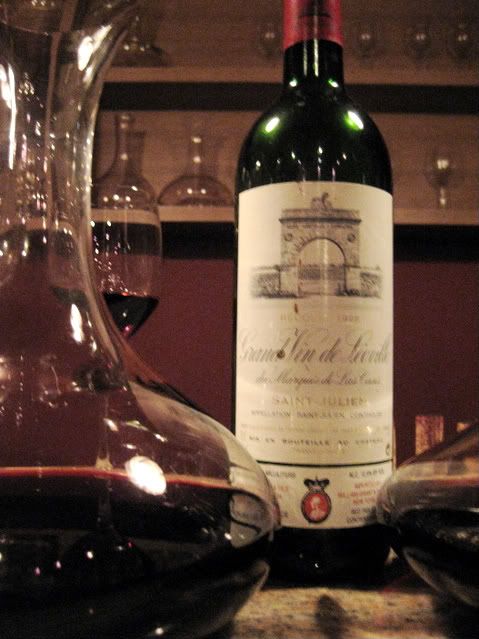 Wine B - Deep, dark, layered fruit, mild licorice, lead pencil. Sweet tea nuances surfaced later on. Not very expressive at this point and there is a detectable gap between individual flavors that, to me, indicates that the wine still needs material time to come together. Very good structure noted though. Solid bones in this.
I couldn't guess what it was (Eric was constantly pestering me to hurry up), and it was later on revealed to be the 1996 Léoville las Cases.
I'm not surprised now that this wine hadn't quite come together yet as las Cases (dubbed a "Super Second" growth in US wine circles due to its quality consistently rivaling that of the 1855 first growths) , in my experience, takes a very long time to reveal its true harmony and resulting beauty.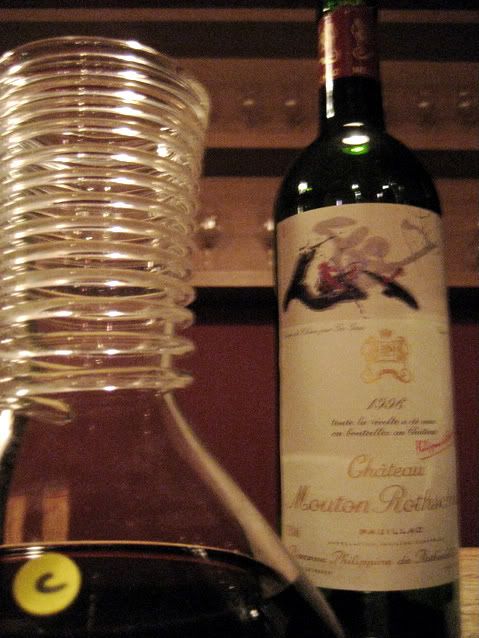 Wine C - Big, wide, a bit muddled at first but eventually settled down after many more minutes into its ripe, luscious, opulently rounded, full-bodied self. Dark chocolate, camphor, Spanish cedar notes. The most open and forward of the reds. Dapper D noted a bit later that it was an especially good pairing with the steak.
Due to its comparative forwardness and openness even at this young stage (for a Médoc first growth, that is), together with its pronounced dark chocolate and luscious mouthfeel, I guessed it to be the Mouton Rothschild.
Mouton Rothschild, nurtured for decades by the late Baron Phillipe de Rothschild, was originally the highest ranked second growth in the 1855 classification. It rose to the rank of first growth in 1973, the only one to ever change rank in the 1855 classification.
The wine turned out to be the 1996 Mouton Rothschild.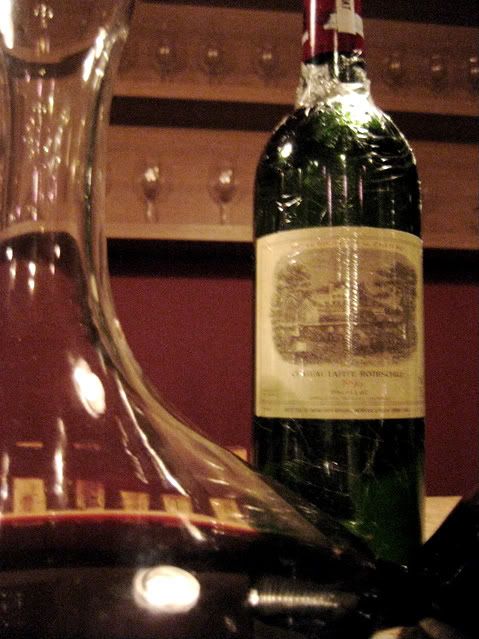 Wine D - Minty nose with ripe cranberry nuances over ripely sweet cassis. Broad and elegant mid-mouth with whispers of anise, tea leaf and violets hanging in the long black fruit finish.
After a while, I noticed unresolved tannins in the finish, but this is hardly surprising for a first growth this age. I jotted it down as the Lafite.
It was later revealed to be the 1996 Lafite Rothschild. It must have been a lucky guess since I don't recall ever having bought a Lafite grand vin myself due to its astronomic prices; I used to drink my father's bottles (memorable were his 1978s and 1979s). Luckier still was I for having been able to try this from generous Uncle David, the 1985 from NSF and, once, the 1982 at the house of Dapper D.
I recall, though, at an IWFS blind tasting of 10 Médocs from vintage 1999, I ranked the Lafite 3rd place after Margaux (1st) and Latour (2nd).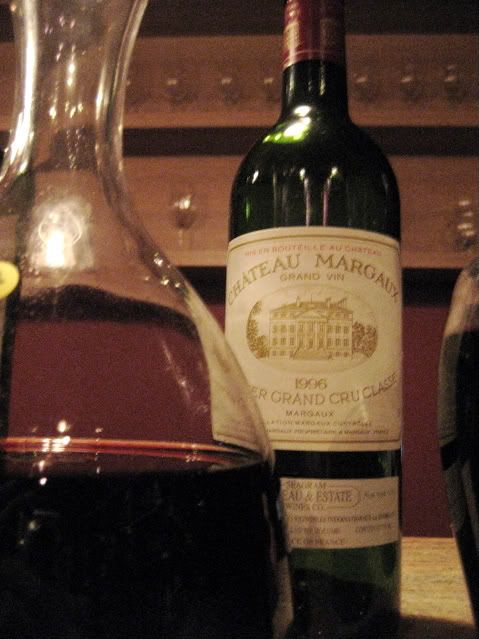 Wine E - My notes become even more telegraphic at this stage since everyone else was starting to vote and I hadn't finished my rankings yet. At blind tastings, I am most always the last to submit and usually feel embarrassed holding everyone else up. The only reasons I take long, though, is because (1) I wish to see how each wine evolves over the evening's span; and, (2) I make several passes on each wine in attempt to give justice to each's merits.
In any event, I recall sweetish herb notes (marjoram?) hovering above a perfumed aroma. Like Wine B, I noted a bit of a diffused feel to it and noted that it still was "not come together".
I was quite surprised when it was revealed to be the 1996 Margaux because, as mentioned, I ranked Margaux 1st place in the 1999 blind tasting and, back in July 2006, wrote that the 2005 Margaux, though an infant, already showed its hallmark elegance and feminine grace. I also predicted that it would turn out to be the most elegant of all the 2005 first growths.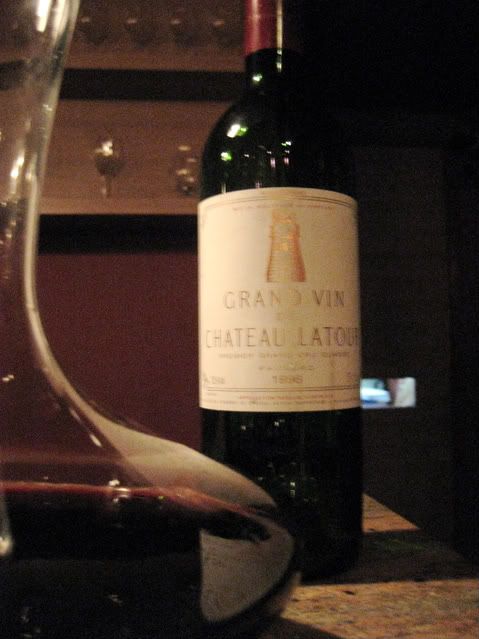 Wine F - Approaching the generosity, weight and fullness of Wine C, but in a more somber, properly reserved manner. Masculine. Neither opulent nor flamboyant, the wine glares back at you, challenging, seemingly daring you to drink it. Layered dark fruit, minerals, graphite, cassis, earthy. There is red berry/fruit on the surface, to be sure, but seems to be wanting to sink deeper into the middle. More terroir driven than fruit, to me. No material chocolate notes noticed.
Again, being rushed, I couldn't write down an educated guess but fleetingly thought it to be the Léoville las Cases. I was wrong. It was the 1996 Latour.
The afternoon before the dinner, I recalled, upon the Doc's prompting, that we had this before at an IWFS Latour vertical held at Bianca's a few years ago. Unfortunately, due to too much wine, I lost the notes I took of that evening. Good thing the Doc reminded me as I had forgotten that I ever had this wine before.
I'm not one who pays much attention to professional scores (my own notes are totally bereft of them), but, since many others are, I looked up Jancis Robinson's (a Masters of Wine degree holder who uses a 20-point scale) ratings from two tastings of the 1996 vintage held in September 2006, as well as the Robert Parker ratings (on a 100-point scale) circulated by the Stockbroker a day or two before the dinner. Here are my own results and the group's collective ranking with the respective scores given by Jancis Robinson ("JR") and Robert Parker ("RP"):
My Own Ranking:
Wine #1 - Wine C, Mouton Rothschild (JR 19, RP 94+)
Wine #2 - Wine F, Latour (JR 18, RP 99)
Wine #3 - Wine D, Lafite Rothschild (JR 18.5, RP 100)
Wine #4 - Wine E, Margaux (JR 17.5, RP 99)
Wine #5 - A tie between Wines A and B: Haut-Brion (JR 18, RP 95) and Léoville las Cases (JR 17, RP 98+)
The Group's Collective Ranking (only until 3rd favorite wine):
Wine #2 - Wine D, Lafite Rothschild (JR 18.5, RP 100)
Wine #3 - Wine E, Margaux (JR 17.5, RP 99)
At the beginning of dinner proper, I made it clear that, as far as I was concerned, ranking this group of wines was an exercise in debating degrees of excellence, and, reiterated after votes were cast that all were quite wonderful in their own ways.The aftermath was just as wonderful. We enjoyed the Stockbroker's Yquem and Gentleman Joe's Rieussec with a simple Vanilla Bean Crème Brûlée with Candied Orange Zest. At that point, I was a bit mentally exhausted from analyzing the reds so I shamefully neglected to write down any notes on these vintages of
the King and Crown Prince of Sauternes. You'll just have to take my word for it that they were both sublime.
Friday, June 27, 2008
Some Backlog Notes: May 2008
May 16th, Old Manila, the Stockbroker's Lunch.
With Eric R., Rod Schiffman, myself, and, of course, our generous host (paired with duck for me and steaks for everyone else):
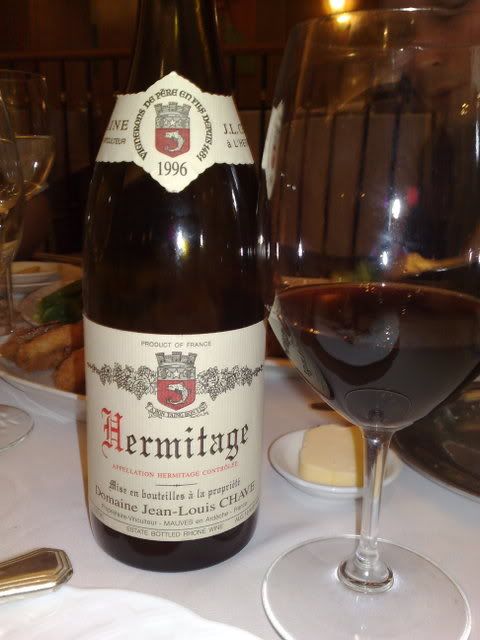 1996 JL Chave Hermitage (Hermitage, Northern Rhône, France) - After a couple of bottles of special whites, from the Stockbroker, I had the best syrah-based wine in my life.
Though I do not have that much experience with syrah-based wine, some of those I've had in the past have certainly been nothing to sneeze at, e.g., 1996 P. Jaboulet Aîné La Chapelle, 1993 Henschke Mt. Edelstone and 1991 Penfolds Grange.
These were all wonderful, but, this definitely stood out amongst them. No need to describe how it looked, you can see it on the right.
Hermitage reds are typically "manly" wines to begin with. This one was especially so, but suave at the same time, not rustic: the earthy, mushroomy, truffled/meaty/leather notes had a subtle, reserved presence, exquisitely interwoven in the fruit (blackberry, cassis, darkly ripe raspberry) and mildest pepper. Though full-bodied, its admirable smoothness and well-knit flavors were not at all cumbersome or heavy. Excellent balance. Excellent wine.
May 17th, Je Suis Gourmand, Dinner.
For Rod & Debby Schiffman's 30th anniversary, with my wife and Robert Burroughes.
Marc Aubry created a menu and special dessert to celebrate the occasion. He is, indeed, a most accomplished chef; all I had to do was tell Marc the date, time, occasion and the wines I intended to bring - he prepared dishes to match everything. That is why Je Suis Gourmand is my favorite restaurant.
We started things off with congratulatory toasts from Robert's bottle of clean, pure, scintillating, vibrant, crisp (which turned creamy to the back of the mouth), toasty NV Pommery Champagne and, with dishes of phyllo-wrapped prawn spring roll atop a roesti-like potato, surrounded by a reduction flavored by prawn heads and shells:
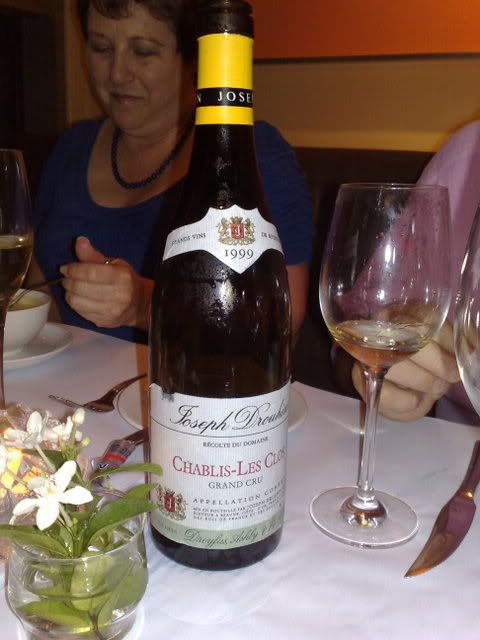 1999 J. Drouhin Chablis Les Clos Grand Cru (Chablis, Northern Burgundy, France) -
Chablis, the real stuff, has been called the purest expression of the chardonnay grape. I agree, though I also think the world of the whites from Puligny-Montrachet and Chassagne-Montrachet.
To me, purity is what it's all about about in Chablis, not luxury, lusciousness or opulence. Chablis means medium-bodied, taut, steely, nervous green apple, just a touch of citrus with hallmark nuances of cold stones, oyster shell/flint/white mineral and only the merest whisper (if any) of oak/vanilla or butter.
I do not favor tropicality or (even slightly obtrusive) oak nuances in Chablis, which is probably why my closest drinking buddies know I prefer premier crus to grand crus except, perhaps, in vintage 2004. This is also why I have learned to avoid buying the wines from the Chablis grand cru vineyard named Bougros.
Les Clos is a grand cru, the grandest of the grand cru vineyards of Chablis, many opine.
So why did I choose this wine for the evening instead of my preferred premier crus (e.g., Montmains, Montée de Tonnerre)? Simple and a bit embarrassing: I went for Les Clos' caché, in honor of the occasion.
The wine was a good grand cru, with the weight and relative density typical of its class and origin, but with accompanying hints of ripe tropicality and a vaguely plumpish lemon-drop feel mid-mouth, and, yes, noticeable oak/vanilla towards the back.
Objectively, it was a fine wine, definitely tasted like it should. Its relative heft stood well against the somewhat creamy prawn shell-and-head reduction. Personally, I would have liked a bit more balancing acidity in the wine for more cut in the pairing and palate-resuscitation between bites.
After a rich soup course with caramelized onions came an earthy main course of roast French pigeon atop a large portobello cap, ceps, potatoes, etc., which we had with a bottle each of:
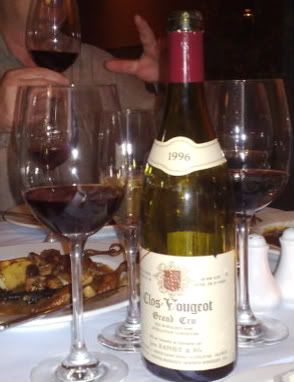 1996 J. Raphet Clos Vougeot Grand Cru (Vougeot, Côte de Nuits, Burgundy, France) -
This wine presented acceptable, if unremarkable, "crunchy", tartish raspberry/strawberry flavors over a relatively shallow dark red fruit base with a touch of old violets. Bit of sappiness, medium-length finish at best.
Not bad, but nothing great. Certainly not up to grand cru standards, but not a bad wine. Best I could say for the wine is that its tartness helped cut the rich earthiness of the dish.
I wouldn't buy the wine again, mainly because there are much better things that may be had at its price range. It was actually quite inexpensive considering it's a grand cru from a good vintage. It didn't seem damaged in any way; that's really all it had to give, unfortunately.
There are definitely better wines out there in the same price range.
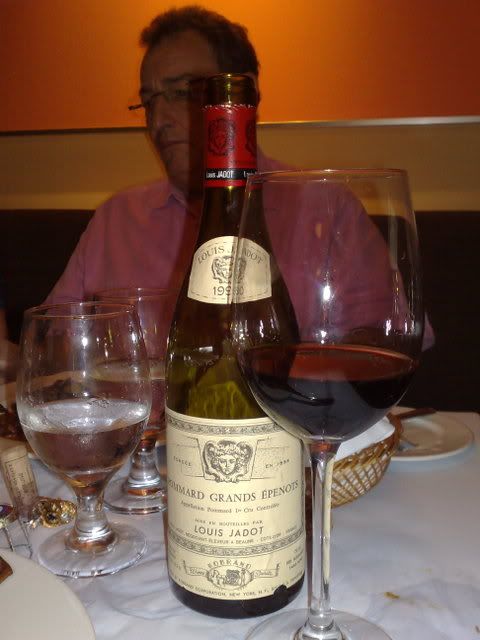 1990 L. Jadot Pommard Grands Épenots Premier Cru (Pommard, Côte de Beaune, Burgundy, France) - This was my kind of wine. Bigger-boned and "beefier" than its refined cousin from urbane Vougeot. This Pommard was a comparative good-ole-boy: rustic, honest, a bit rough around the edges, but with an honest, unself-conscious, comfortable warmth that accompanied its quiet country wisdom and strength.
More depth in its earthy dark fruit base with a soft red beet and mushroom nuances; on the surface, the wine was accented by ripe black cherry and mild raspberry notes. I loved this wine, especially with the roast pigeon.
The pairing was not from the school of cut-and-contrast; rather, it was more of an amiable hand-in-hand, liesurely, yet contemplative, sunset stroll. The wine's inherent earthiness lolled with that of the pigeon, ceps and rustic potatoes. The red beet nuance and red berry/cherry notes added uplifting sweetish fruit-ripeness to the earthy mix.
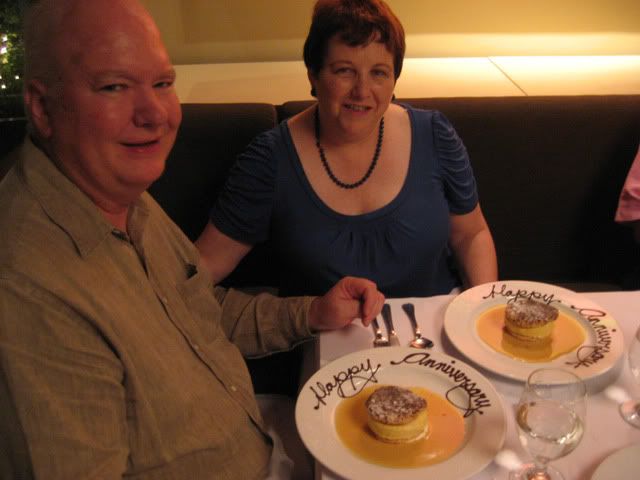 After a generous cheese platter came dessert of absolutely delicious coconut-coffee ice cream "sandwiches" that Marc created for the occasion of our foreign guests' anniversary. We had no sweet wine for pairing, but the dessert didn't need any. It was perfect by itself.
A round of double espressos found its way to our table, followed by complimentary digestifs. Somewhere between the desserts and the digestifs, Marc sat with us and enjoyed a quick glass of bubbly from his hometown of Champagne.
In terms of food, wine and company, it was a most memorable dinner. Merçi beaucoup, Marc.
May 27th, Tivoli, Lunch.
With Rod and Debby Schiffman. With assorted starters of fresh oysters, salmon, eel, etc., we had a simple, straightforward, crisp Marlborough NZ sauvignon blanc that I picked off the restaurant's wine list. With identical main courses of excellently roasted medium-rare medallions of veal, Rod, Debby and I enjoyed a bottle of :
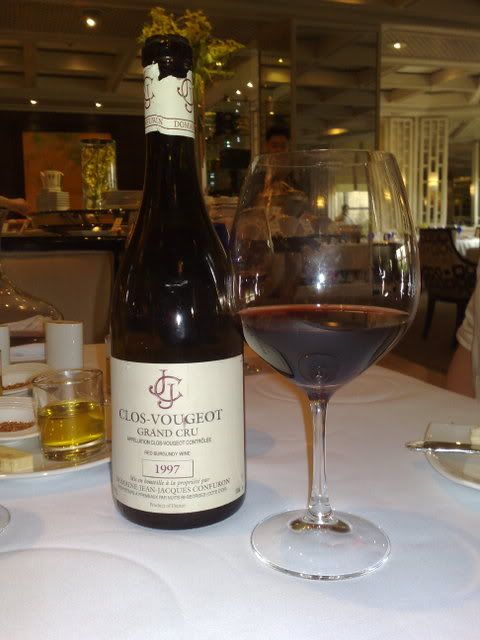 1997 JJ Confuron Clos Vougeot Grand Cru (Vougeot, Côte de Nuits, Burgundy, France) -
This was a proper grand cru from Clos Vougeot, much more befitting of its status and expressive of terroir than the '96 by J. Raphet.
Though the ripe 1997 vintage was much heralded at the outset, particularly for the reds of the Côte de Nuits, relatively low acidity that generally marked the wines subsequently dampened many an expectancy of general age-worthiness.
Well, to the '97 detractors, here is one that wears its age well and elegantly. It was an excellently kept bottle to begin with, kudos to Vinfolio in San Francisco.
Deep, complex, full-bodied, it displayed dark red cherry and ripe raspberry, violets, a mere touch of spicy wood with discreet cassis and dark fruit undertones. Yes, the touch of nostalgic Burgundy decay was there, which always does me in. Long, confident, spicy finish. I loved this wine.
With Eric R., Rod Schiffman, myself, and, of course, our generous host (paired with duck for me and steaks for everyone else):
1996 JL Chave Hermitage (Hermitage, Northern Rhône, France) - After a couple of bottles of special whites, from the Stockbroker, I had the best syrah-based wine in my life.Though I do not have that much experience with syrah-based wine, some of those I've had in the past have certainly been nothing to sneeze at, e.g., 1996 P. Jaboulet Aîné La Chapelle, 1993 Henschke Mt. Edelstone and 1991 Penfolds Grange.
These were all wonderful, but, this definitely stood out amongst them. No need to describe how it looked, you can see it on the right.
Hermitage reds are typically "manly" wines to begin with. This one was especially so, but suave at the same time, not rustic: the earthy, mushroomy, truffled/meaty/leather notes had a subtle, reserved presence, exquisitely interwoven in the fruit (blackberry, cassis, darkly ripe raspberry) and mildest pepper. Though full-bodied, its admirable smoothness and well-knit flavors were not at all cumbersome or heavy. Excellent balance. Excellent wine.
May 17th, Je Suis Gourmand, Dinner.
For Rod & Debby Schiffman's 30th anniversary, with my wife and Robert Burroughes.
Marc Aubry created a menu and special dessert to celebrate the occasion. He is, indeed, a most accomplished chef; all I had to do was tell Marc the date, time, occasion and the wines I intended to bring - he prepared dishes to match everything. That is why Je Suis Gourmand is my favorite restaurant.
We started things off with congratulatory toasts from Robert's bottle of clean, pure, scintillating, vibrant, crisp (which turned creamy to the back of the mouth), toasty NV Pommery Champagne and, with dishes of phyllo-wrapped prawn spring roll atop a roesti-like potato, surrounded by a reduction flavored by prawn heads and shells:
1999 J. Drouhin Chablis Les Clos Grand Cru (Chablis, Northern Burgundy, France) -Chablis, the real stuff, has been called the purest expression of the chardonnay grape. I agree, though I also think the world of the whites from Puligny-Montrachet and Chassagne-Montrachet.
To me, purity is what it's all about about in Chablis, not luxury, lusciousness or opulence. Chablis means medium-bodied, taut, steely, nervous green apple, just a touch of citrus with hallmark nuances of cold stones, oyster shell/flint/white mineral and only the merest whisper (if any) of oak/vanilla or butter.
I do not favor tropicality or (even slightly obtrusive) oak nuances in Chablis, which is probably why my closest drinking buddies know I prefer premier crus to grand crus except, perhaps, in vintage 2004. This is also why I have learned to avoid buying the wines from the Chablis grand cru vineyard named Bougros.
Les Clos is a grand cru, the grandest of the grand cru vineyards of Chablis, many opine.
So why did I choose this wine for the evening instead of my preferred premier crus (e.g., Montmains, Montée de Tonnerre)? Simple and a bit embarrassing: I went for Les Clos' caché, in honor of the occasion.
The wine was a good grand cru, with the weight and relative density typical of its class and origin, but with accompanying hints of ripe tropicality and a vaguely plumpish lemon-drop feel mid-mouth, and, yes, noticeable oak/vanilla towards the back.
Objectively, it was a fine wine, definitely tasted like it should. Its relative heft stood well against the somewhat creamy prawn shell-and-head reduction. Personally, I would have liked a bit more balancing acidity in the wine for more cut in the pairing and palate-resuscitation between bites.
After a rich soup course with caramelized onions came an earthy main course of roast French pigeon atop a large portobello cap, ceps, potatoes, etc., which we had with a bottle each of:
1996 J. Raphet Clos Vougeot Grand Cru (Vougeot, Côte de Nuits, Burgundy, France) -This wine presented acceptable, if unremarkable, "crunchy", tartish raspberry/strawberry flavors over a relatively shallow dark red fruit base with a touch of old violets. Bit of sappiness, medium-length finish at best.
Not bad, but nothing great. Certainly not up to grand cru standards, but not a bad wine. Best I could say for the wine is that its tartness helped cut the rich earthiness of the dish.
I wouldn't buy the wine again, mainly because there are much better things that may be had at its price range. It was actually quite inexpensive considering it's a grand cru from a good vintage. It didn't seem damaged in any way; that's really all it had to give, unfortunately.
There are definitely better wines out there in the same price range.
1990 L. Jadot Pommard Grands Épenots Premier Cru (Pommard, Côte de Beaune, Burgundy, France) - This was my kind of wine. Bigger-boned and "beefier" than its refined cousin from urbane Vougeot. This Pommard was a comparative good-ole-boy: rustic, honest, a bit rough around the edges, but with an honest, unself-conscious, comfortable warmth that accompanied its quiet country wisdom and strength.More depth in its earthy dark fruit base with a soft red beet and mushroom nuances; on the surface, the wine was accented by ripe black cherry and mild raspberry notes. I loved this wine, especially with the roast pigeon.
The pairing was not from the school of cut-and-contrast; rather, it was more of an amiable hand-in-hand, liesurely, yet contemplative, sunset stroll. The wine's inherent earthiness lolled with that of the pigeon, ceps and rustic potatoes. The red beet nuance and red berry/cherry notes added uplifting sweetish fruit-ripeness to the earthy mix.
After a generous cheese platter came dessert of absolutely delicious coconut-coffee ice cream "sandwiches" that Marc created for the occasion of our foreign guests' anniversary. We had no sweet wine for pairing, but the dessert didn't need any. It was perfect by itself.A round of double espressos found its way to our table, followed by complimentary digestifs. Somewhere between the desserts and the digestifs, Marc sat with us and enjoyed a quick glass of bubbly from his hometown of Champagne.
In terms of food, wine and company, it was a most memorable dinner. Merçi beaucoup, Marc.
May 27th, Tivoli, Lunch.
With Rod and Debby Schiffman. With assorted starters of fresh oysters, salmon, eel, etc., we had a simple, straightforward, crisp Marlborough NZ sauvignon blanc that I picked off the restaurant's wine list. With identical main courses of excellently roasted medium-rare medallions of veal, Rod, Debby and I enjoyed a bottle of :
1997 JJ Confuron Clos Vougeot Grand Cru (Vougeot, Côte de Nuits, Burgundy, France) -This was a proper grand cru from Clos Vougeot, much more befitting of its status and expressive of terroir than the '96 by J. Raphet.
Though the ripe 1997 vintage was much heralded at the outset, particularly for the reds of the Côte de Nuits, relatively low acidity that generally marked the wines subsequently dampened many an expectancy of general age-worthiness.
Well, to the '97 detractors, here is one that wears its age well and elegantly. It was an excellently kept bottle to begin with, kudos to Vinfolio in San Francisco.
Deep, complex, full-bodied, it displayed dark red cherry and ripe raspberry, violets, a mere touch of spicy wood with discreet cassis and dark fruit undertones. Yes, the touch of nostalgic Burgundy decay was there, which always does me in. Long, confident, spicy finish. I loved this wine.
Sunday, June 22, 2008
IWFS Night Of Authentic Austrian Cuisine & Wine.
Thursday, 22 May 2008 at Aubergine, the International Wine & Food Society Philippine Branch held a dinner featuring authentic Austrian cuisine and accompanying wine, organized by Othmar Ober.
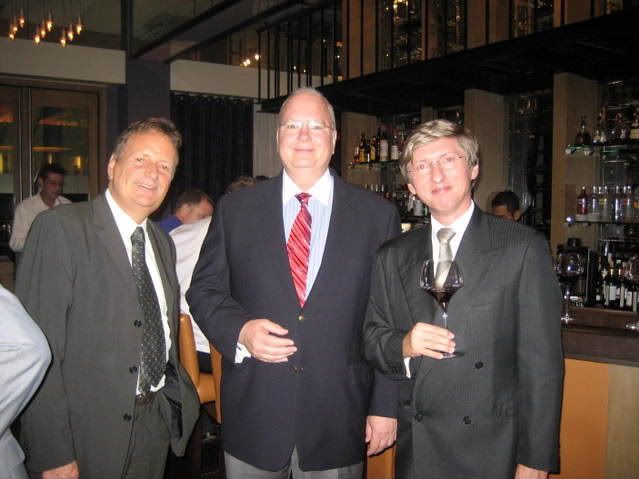
L-R: the Austrian Financial Attaché, Rod Schiffman of Westcoastwine.net and Othmar Ober.
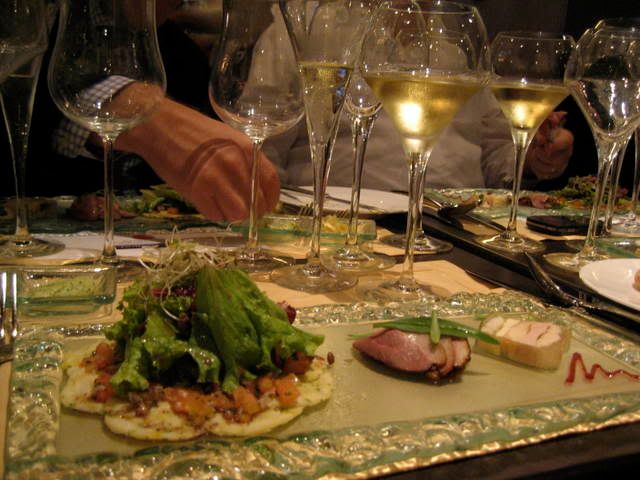
The next course was Oven Roasted Veal Shank in Natural Gravy and Duck "Groesti", served with Braised Red Cabbage and Morel-Bread Pudding which was paired with 2002 Cuvée Vincent CF/CS/ZW by Weingut Bründlmayer - Othmar sat and spoke with me about this wine and I forgot to take a picture of it as well as the dish (I put the blame on him, in any event). I now understand that the wine is made up of (in descending proportions): "CF" (cabernet franc), "CS" (cabernet sauvignon) and "ZW" (Zweigelt, a grape I've never before heard of).

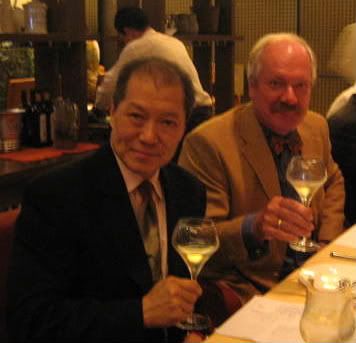
L-R: the Austrian Financial Attaché, Rod Schiffman of Westcoastwine.net and Othmar Ober.
For welcome bubbly, continuing with the amuse bouche:
(L-R: Johnson U, Edouard M, Mike T & Louie L)
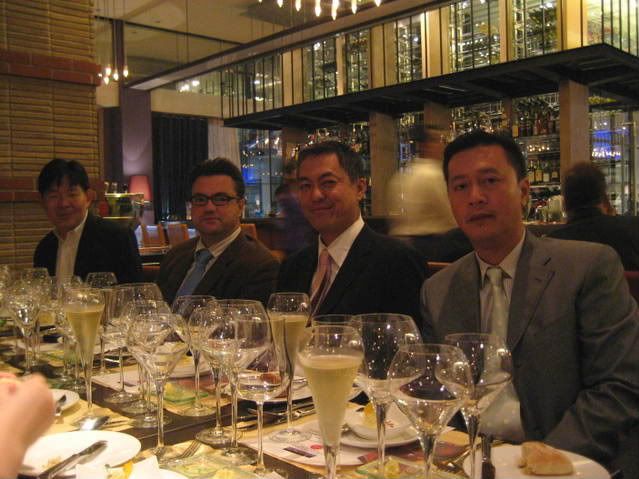
2004 Sekt Bründlmayer Brut by Weingut Bründlmayer - According to Othmar, this attractive, brilliant pale straw-yellow, apple-green tinged bubbly is composed of pinot noir, pinot blanc (a.k.a., weissburgunder), chardonnay and a tiny bit of grüner veltliner.
Very dry and crisp with healthy, bracing acidity, I initially thought there was was more grüner veltliner to this due to fresh touches of green bean, lentils and bell pepper in the aroma. The raciness/freshness in the attack fleshed out somewhat mid-palate where one could feel the weight of the chardonnay and the subtle rounded feel of the pinot blanc. A minerally backbone propped up the mellow primary apple, pear and white stone fruit nicely. Over-all general impressions were of clean lines, sharp focus and purity. Very easy to drink a lot (read: too much) of this in the heat of summer.
With my favorite course of the night, Carpaccio of Napkin-Dumpling in Tomato Vinaigrette and Pumpkin Seed Oil with Assorted Salad Leaves, Home-Smoked Duck Breast and Terrine of Smoked Rainbow Trout with Horseradish-Cranberry Mousse:
2005 Grüner Veltliner Terrassen Federspiel by Domaine Wachau - Those unfamiliar with one of the traditional grapes for Austrian white wines, grüner veltliner, will detect familiar grapefruit/grassy/gooseberry notes reminiscent of ubiquitous sauvignon blancs from Marlborough, New Zealand, albeit of a milder, more reserved, self-possessed character. This is where the similarity ends, however, as this wine also displays a bit of green apple, touch of lime, and finely-interwoven fresh, vegetal and spice notes (green beans, lentils, green pepper, white pepper). Pleasantly dry, this was quite versatile providing cut and lift to the smoked duck breast, body and substance to the salad, while adding brightness to the napkin-dumpling and trout terrine.
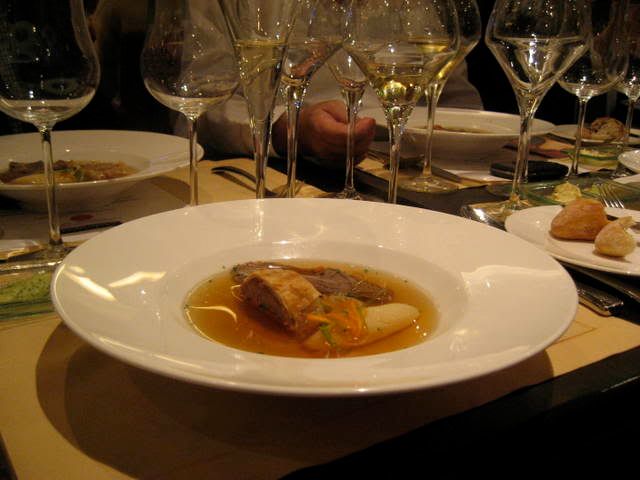
With the next two courses of Tafelspitz Consommé with Meat Strudel, Sliced Beef, Semolina Dumpling and Poached Quail Egg (nb: mine lacked the quail egg for some reason, but I didn't bother saying anything at the time):
- and -
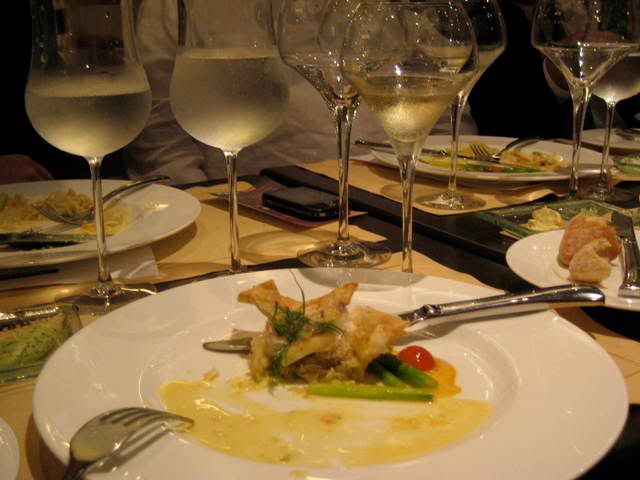
Sander Fillet, Champagne Sauerkraut Baked in a Strudel Leaf on Riesling Sauce:
2006 Langenloiser Riesling Kamptaler Terrassen by Weingut Bründlmayer - Though very young, it already exhibited the petrol/gas notes (a.k.a., goût de pétrole) typical of mature/older rieslings towards the back of the mouth and in the finish. I think this threw those not very familiar with rieslings a bit off as I received a few questions about it and had to explain that this was really a characteristic of, and not a defect in, the wine.
Clear, limpid, pale straw-yellow with a just-barely-discernable light greenish tinge, its somewhat tight aroma called to mind small white flowers, white fruit, unripe peach and mere hints of citrus. Pleasant enough, sufficiently balanced and, to me, very approachable, though, due likely to its youth, it did not display any material depth. At this point, it is accessible, entertaining and charming enough in a light-hearted way, which, I think, is all one could or should reasonably expect from it now.
As regards the dishes and pairing: I didn't have the consommé with wine but felt it was a fine pairing with the Sander (which is hardly surprising). Louie L. particularly enjoyed the consommé and expressed praise for the finesse of the sliced beef and delicate fullness of the broth's flavors.
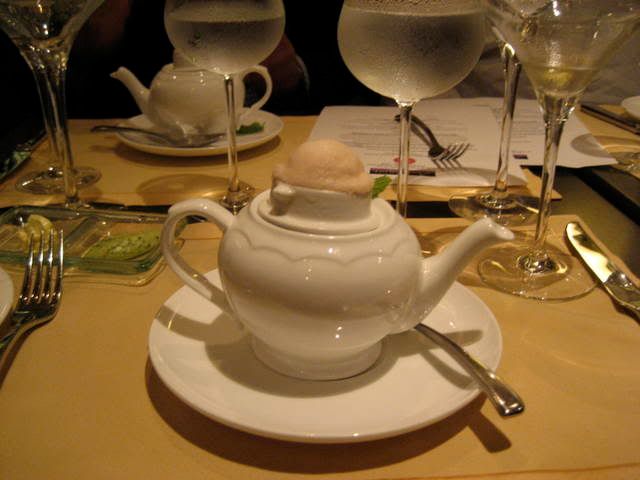
Elderberry Sherbet
The next course was Oven Roasted Veal Shank in Natural Gravy and Duck "Groesti", served with Braised Red Cabbage and Morel-Bread Pudding which was paired with 2002 Cuvée Vincent CF/CS/ZW by Weingut Bründlmayer - Othmar sat and spoke with me about this wine and I forgot to take a picture of it as well as the dish (I put the blame on him, in any event). I now understand that the wine is made up of (in descending proportions): "CF" (cabernet franc), "CS" (cabernet sauvignon) and "ZW" (Zweigelt, a grape I've never before heard of).
Before being briefed by Othmar, I simply couldn't grab a handle on the wine. It puzzled me to no end and I couldn't guess what it was (save, obviously, that it was Austrian). It was ripely sweetish red-fruit dominated (cherry, raspberry) over blackcurrant/cassis, slight violets, with a distinct touch of black pepper. Medium-bodied, it was smooth enough on the palate and had a somewhat comforting warmth about it.
I think my unfamiliarity with the wine/varietals, coupled with my strong personal preferences (read: dog-headedness) got the better of me. I couldn't quite get this enigmatic wine; though, admittedly, I liked it more with the veal. Edouard (he with centuries of Bordeaux running through his veins) and Jérome (Manila's resident French, Non-Bordeaux Crusader) told me they thought it was good enough, a nice novelty and that it grew on one the more one sipped it.
Then came my second favorite course of the evening, a virtual parade of curiously sounding delights: Quark-Dumpling, Kaiserschmarren with Plum Roester, Tossed Poppy Seed Noodles with Home-Made Apricot Ice Cream, paired with...
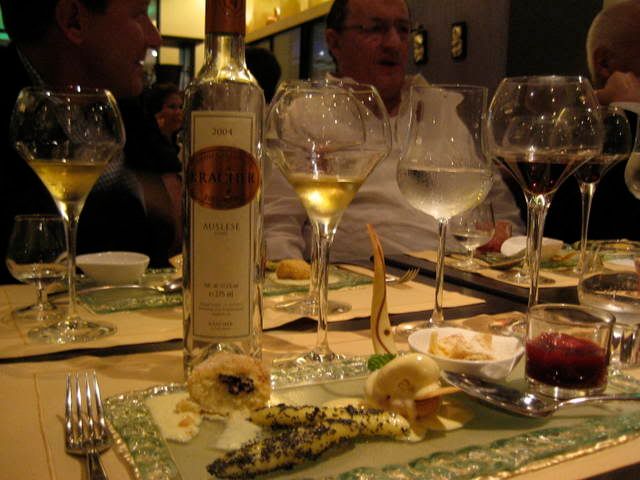
 2004 Auslese Cuvée by Weinlauobenhof Alois Kracher - As far as I could find out from Othmar and Bernie S., this wine is made up of chardonnay and welschriesling, harvested late and touched with botrytis cinerea (referred to as Edelfäule in German), which touch totally throws me for a loop in trying to guess varietal composition (I can only get it when it is very obvious like in the cases of gewürtztraminers and, most of the time, with furmint-based Tokaji Aszu). Though I have very limited exposure to the wines of the late Alois Kracher, I was aware that he was virtually without peer in Austria when it came to making dessert wines. I have the good fortune of having tried a few of their trockenbeerenauslese, and they are quite sinful indeed.
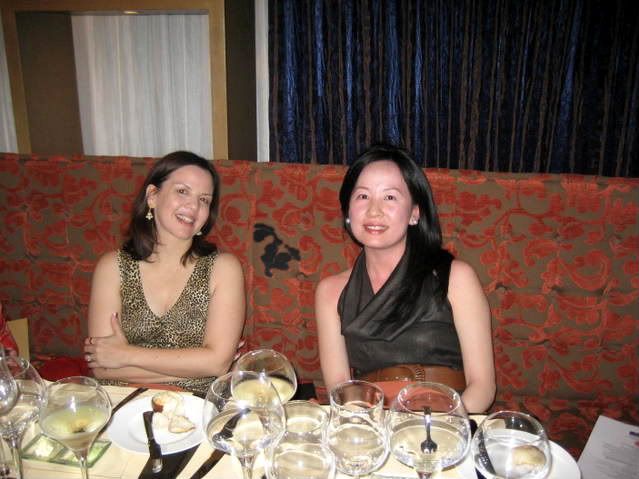
Not quite as richly "botrytised" as the more familiar sweet wines of Sauternes/Barsac, I felt this auslese was closer to the vendages tardives wines of Alsace - this, perhaps, with marginally less botrytis. Straightforward and enjoyable honeyed apricot, peach and a whisper of orange rind, its sweetness is adequately balanced by acidity. Straightforward, good and, importantly, locally available. I recall the wives liked this wine.
As far as I was concerned, however, the Austrian desserts demanded and deserved center stage. Particularly, the quark-dumpling and toasted poppy seed noodles were absolutely delightful and memorable. I can still taste them now as I write. Hopefully, I can somehow convince the chef at Aubergine to re-execute this for me sometime.
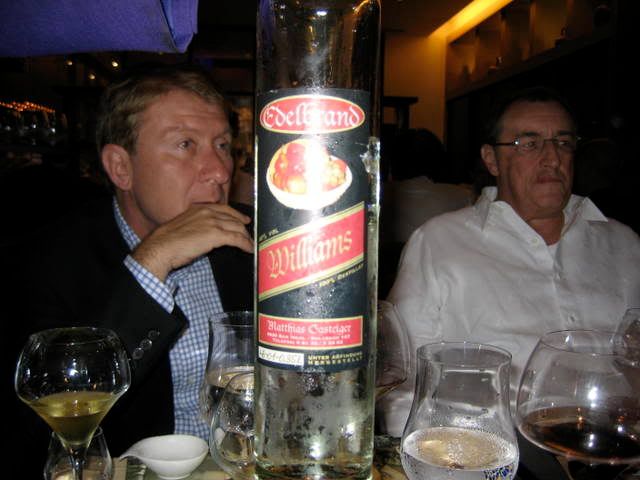
To cap off the evening, Othmar generously shared his last bottle of Edelbrand Williams. It was a good thing I had a driver that evening as I wound up tipsier than I thought I would.
This was a memorable night as it was the first time I ever had a taste of authentic, fine Austrian cuisine, with each course carefully paired with Austrian wine no less. Short of visiting Austria, one would have to look long and hard for a similar experience in the Philippines. This is one of the many reasons I am glad I joined the IWFS. Of course, learning from and enjoying the company of like-minded friends certainly don't hurt.
Friday, June 20, 2008
Oscar Night at l'Opera.
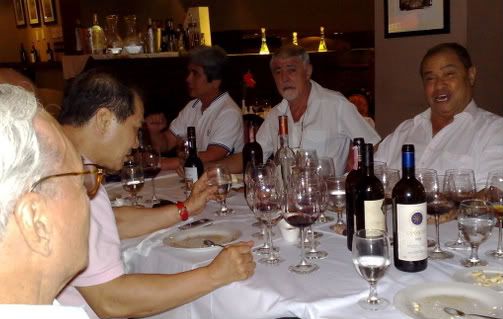 13 June 2008 at l'Opera.
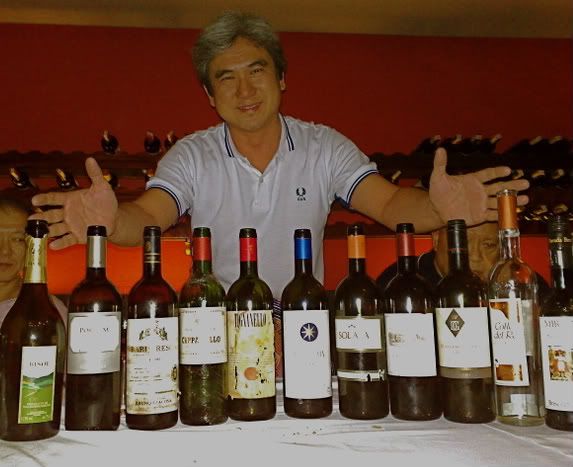
I was invited to join the International Wine & Food Society's (IWFS) board members for dinner, hosted this month by Oscar Ong. All the food and wines (well, all but two) were on him.
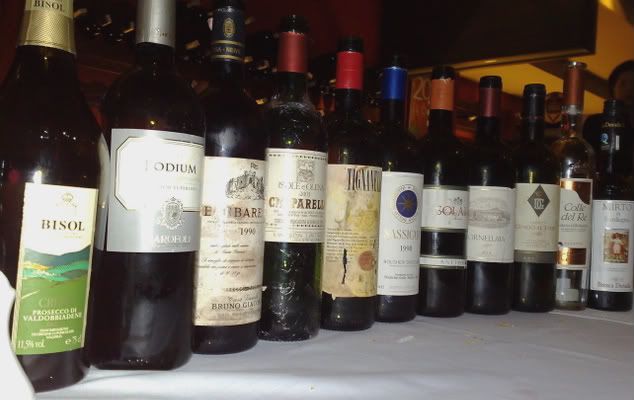
The IWFS Board, L-R: Oscar, Bill Stone, Rene Fuentes, Sunny Gracia, Markus Ruckstuhl, Freddy Wieneke, Bernie Sim, Freddie Pio de Roda and Fil Juntereal.
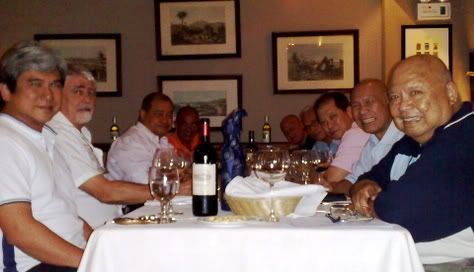
The Wines. After some glasses of dangerously drinkable Bisol Crede Prosecco di Valdobbiadene:
2004 Garofoli Verdicchio dei Castelli di Jesi Classico Superiore "Podium" - Dry, slightly crisp attack, fleshing out incrementally with suggestions of tropicality mid-mouth. Some demure grapefruit and mild citrus. Suave on the palate with decent structure and balance. Mild fennel and an appetizing slight almondy bitterness surface towards the back, through to the finish.
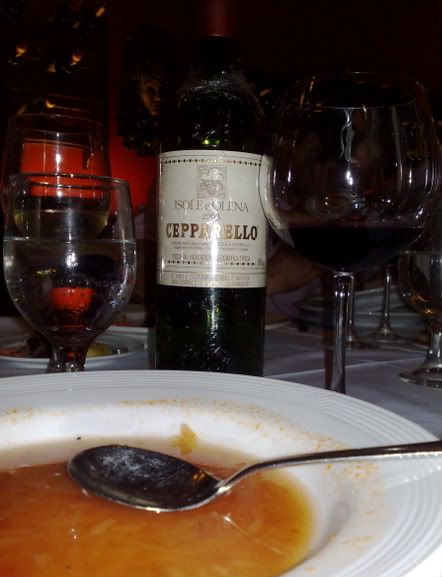
2003 Isole e Olena Cepparello - Bernie brought this bottle to share, and we had it with a light onion and tomato soup. This wine looked bigger than it tasted, gentle and serene (almost soft) despite its ominous darkness, lithely medium-bodied, ripe red berries lace blackcurrant, cassis, merest hint of anise and wood. I honestly thought it would be too young and heavy since it looked darkly intense, but I was wrong. Good pairing.
Grilled meats were served (rib-eye, lamb, etc.), and Oscar started pouring the big boys:
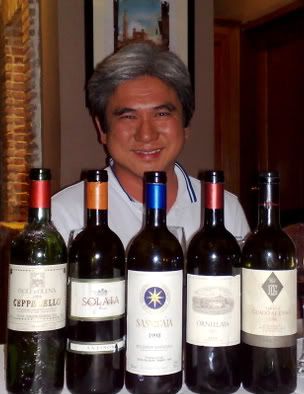
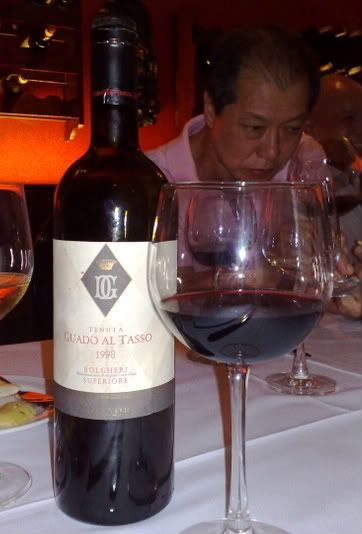 1998 Antinori Tenuta Guado al Tasso Bolgheri Superiore - Though obviously heavier-boned than the preceding wine, again, it was not as big as I thought it would be, but that is a good thing (for me, anyway). Mildly earthy, smoky and herbaceous; nicely warming blackcurrant-and-cassis-dominated with light touches of raspberry liqueur and alluring black olive, sweetish tobacco, mild vanilla and dark spice notes. Good weight, nice balance.
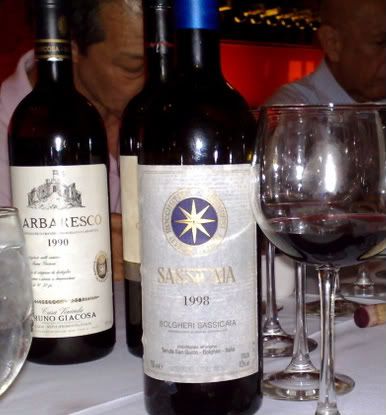
1998 Tenuta San Guido Bolgheri Sassicaia - Marginally heftier/more masculine than the Guado al Tasso but, seemingly, a bit lighter on its feet, with better structure, more noticeable slightly dry wood notes, earthier (touch of truffle) and more definitive/confident all-around. Black coffee and hints of mushroom underpin the dark fruit. Violet notes surface towards the back. Nice depth, firm structure. Beside this, the Guado al Tasso seemed sweetish with riper fruit. This cut the grilled steak very nicely and ran with the earthy ball. I think this paired best with the grilled meat.
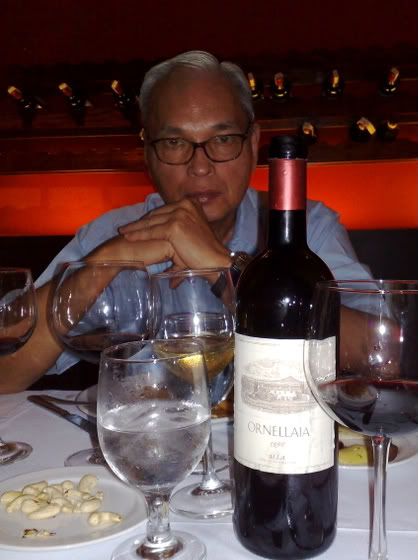 1998 Tenuta dell'Ornellaia Bolgheri Superiore - This was, to me, the most enjoyable/"crowd-pleaser" wine of the night. Bigger, fleshier, more forward/accessible than, though not as firm/definitive or masculine as, the Sassicaia. The Ornellaia had a lusher, more amiable character to it. With a more rounded and pronounced mid-palate, cherry/kirsch highlighted velvety, molten dark fruit with luxurious notes of leather, espresso and dark spice underneath. Very enjoyable (dare I use the word "hedonistic"), if not as contemplative as the Sassicaia.
1998 Antinori Solaia - I had this before during my birthday dinner in 2006 and, while I enjoyed it well enough, I then found the thick, viscous black fruit (infused with sweet tobacco, spice box notes and vanilla/oak) base a bit over-ripe, over-extracted, almost pruney. I didn't get to re-taste it this night though as the bottle emptied out before it reached my glass.
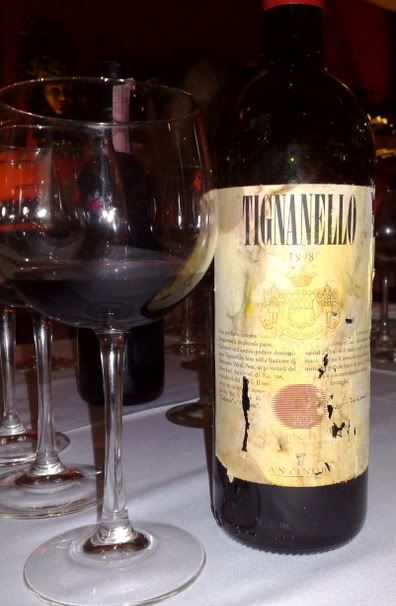 1998 Antinori Tignanello - Masculine wine, not as somber as the Sassicaia, but of a similar serious nature. Its dry, strawberry/raspberry surface over earthy cassis, slight pencil lead and leather notes were displayed on a comparatively dense (not cumbersome though), fullish body. Admirable length and balance.
1990 Bruno Giacosa Barbaresco - I had this comparatively (much) lighter wine while Bernie and Rene discussed its composition and origins. There were 2 bottles of this, Bernie brought one too. Ironically, the wine from the scruffy looking bottle tasted fresher and younger than the one from the pristine-looking one. Though obviously lighter in appearance and in weight, this wine acquitted itself well with its smooth, though potent, truffled, black olive, graphite, earthy, tar-touched flavors over thinning fruit.This had a nice, rustic, nostalgic feel to it. I think I enjoyed this more than the others. Lucky me, I poured and enjoyed at will.
With dessert of, probably the best panna cotta in Manila:
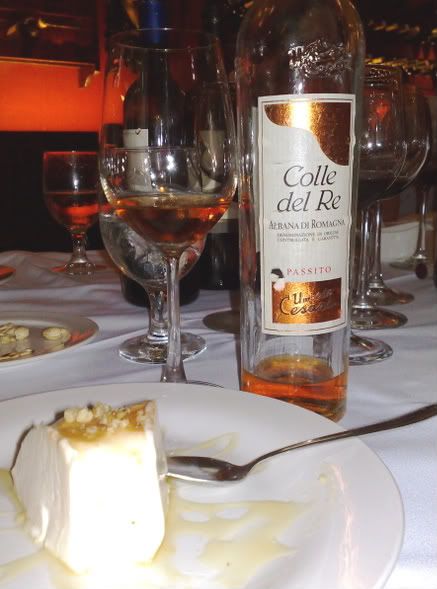
Umberto Cesari Colle del Re Albana di Romagna Passito - I didn't (and don't) see any vintage on the bottle, so I wouldn't know what vintage it is from (if, indeed it is a vintage wine). In any event, it is a straightforward, unpretentious, sweet, viscous, honeyed, vanilla-laced, white raisiny wine that I enjoyed greatly with my panna cotta - an overly-indulgent dessert pairing which was right up my alley. With all the over-indulgence that already took place, why stop now?
I understand it is quite inexpensive and locally available at Bacchus. Definitely good news: an inexpensive dessert wine in a small format that one can pop open any time.
Thereafter came a curious digestif:
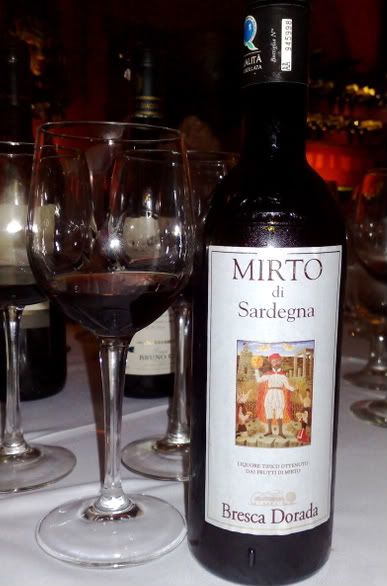 Mirto di Sardegna - Bernie warned me that it would, to put it nicely, guarantee expeditious digestion. A thick, dense, herby, syrupy liqueur that tastes of anise and dark molasses. The herb-bitterness surfaces far in the back and continues to a bittersweet finish. If anyone has tried the anise-laden German digestif called "Underberg", think of a thick and sweetened version of it and you've pretty much gotten what this tasted like. Amusing, a novelty, and effective. My over-worked-stomach discomfort was noticeably eased. I think only Oscar and I appreciated it though.
What a night! Molto grazie, Oscar! Bravo!
Thursday, June 19, 2008
Some Wines from Domaine Bott-Geyl.
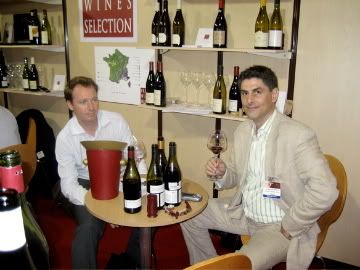 After tasting through as much as I could at the UGC in Vinexpo Asia-Pacific 2008, I visited the booth of Manila's non-Bordeaux crusader, Jérome Philippon of Sommelier Selection. A bit busy entertaining customers, Jérome introduced me to Valerie Bott-Cartier, winemaker of Domaine Bott-Geyl (based in Beblenheim, Alsace), and, incidentally, the wife of domaine owner, Jean Cristophe (who was back home, hard at work in the vineyards).
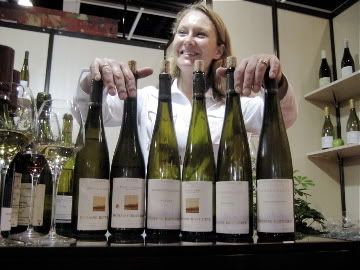
Valerie and Jérome:
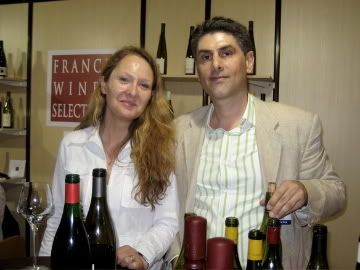
I am familiar with the domaine's bottlings distributed by Jérome in Manila and have actually purchased and consumed quite a number of them, but never got to try their "higher bottlings" as none are currently available on the local market. Don't get me wrong, while I, and, I am sure, many others, are happy with the line Jérome currently brings in (particularly with a well-chilled bottle of their gewürztraminer with Je Suis Gourmand's terrine of foie gras - I understand their same wine is featured as a pairing to foie gras in the 3 Michelin star Auberge d'Ill in Illhaeusern, Alsace), I do hope he soon starts bringing in the lines subject of this post.
After proper introductions and a good-natured "scolding" from Valerie for my not having passed by her family domaine after finding out I was in nearby Riquewihr for several days late last September, she walked me through a few of her wines.
Domaine Bott-Geyl:
2005 Riesling Grafenreben de Zellenberg - Very lively, refreshing, crisp and clean (a proverbial "breath of fresh air" after having tasted around 35 young Bordeaux reds in the last 2-½ hours) dry young riesling with tense minerality to its currently dominant citrus/lemon/lime and whispers of white flowers over a slightly rounded underbelly of ripish stone fruit. Lots of finesse to this wine.
I've found young rieslings from taditional Alsace makers (e.g., Léon Beyer) are usually noticeably tight, as this one was, but predict that the underlying rounded stone fruit will surface materially after the proper number of years' ageing. I think this has excellent potential and certainly will try to track this wine's progress over the years.
2005 Pinot Gris "Les Elements" - this is the line that Jérome distributes in Manila and I am quite familiar with the 2004 version. The 2005, while exhibiting the dry style of traditional Alsace makers, was notably riper, rounder and "sexier" than its 2004 version, approaching voluptuous. Nice. Valerie recommends it with a terrine of foie gras.
2004 Pinot Gris Sonnenglanz (Grand Cru) - Mildly spicy ripe melon, lemon drop with entertaining hints of almond paste beneath and to the back. Smooth on the palate with nice weight and balance, and a slight richness that made me think even more of having some foie gras.
2004 Gewürztraminer Sonnenglanz (Grand Cru) - Unmistakably gewürz, redolent with a heady perfume of lychee and peach, with touches of roses and small white flowers delivered to the palate in a clean, pure and admirably balanced format. Excellent, memorable.
2001 Pinot Gris Sonnenglanz (Grand Cru) Vendanges Tardives - Good, solid, very ripe, rounded, mildly-honeyed fruit base with a well-integrated nuttiness underneath, a touch of minerality and an alluring ever-so-slight tanginess (which, to me, helped balance off the sweet ripeness of this VT. Nice complexity if one pays proper respect and attention to it.
If there is a single word I can come up with to describe the general character of these wines, it would have to be "honest". I feel "honest" captures their natural, unsullied, unmanipulated, unpretentious allure.
Jérome mentioned to Valerie that my wife loves Alsace VTs, and, thus, after proper thanks given and good-byes said, I was off on my way with a gift of a bottle of the 2001 Pinot Gris Sonnenglanz VT for her.
Walking back to my hotel, I thought about the thing I loved most about Alsace. Though, while there, the food was, indeed, good and the white wines wonderful, it was the honest warmth, openness and friendliness of the people that struck me the most. This short meeting reminded me of that.
Saturday, June 14, 2008
Wine Dinner: Bordeaux and a Napa, 11 June 2008.
This past Wednesday night was at Santi Araneta's place. The food was courtesy of his (much) better half, Maite, while we all brought some bottles to share. The event took place in Santi's den which was a special treat for me since we could smoke in air-conditioned comfort while eating and drinking.
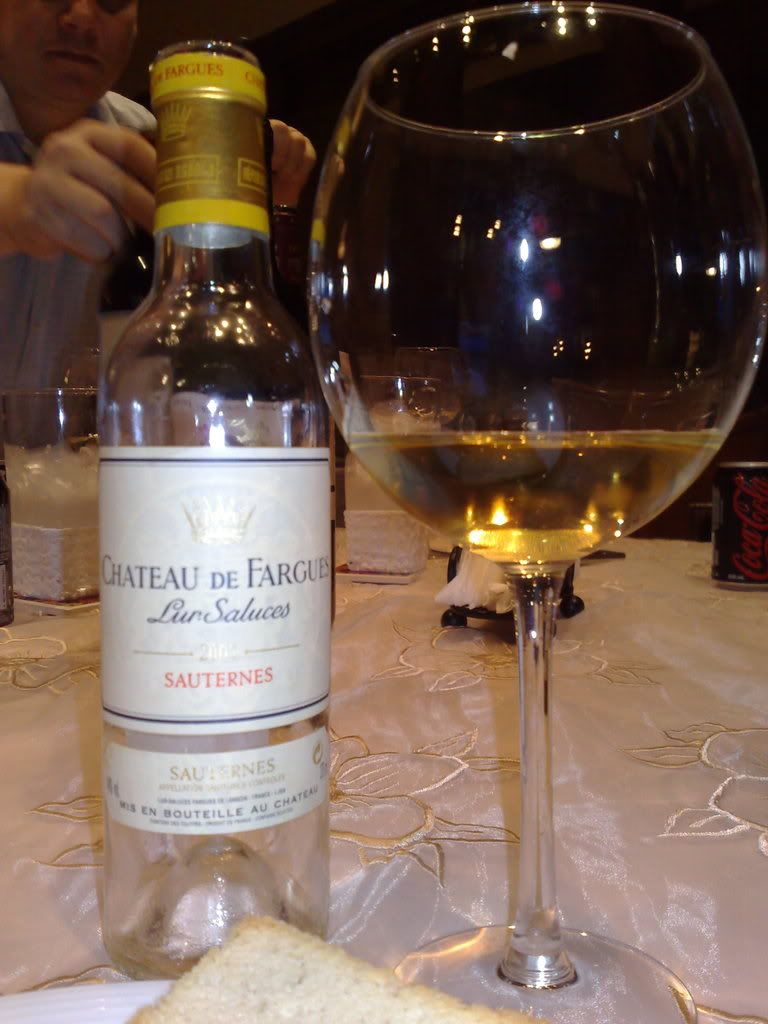 Not wasting any time, to pair with a pâté en terrine of foie gras, Santi broke out a half bottle of 2002 Château de Fargues - from a Sauternes estate of which few people are aware has been owned and run since the late 1700s by the Lur Saluces family of d'Yquem fame. The oldest de Fargues I've had to my immediate recollection was a sublime 1986, enjoyed 3 years ago (See: my old notes).
Though it has a lot of maturing to do, this lass is a precocious one; supple with a teen-ager's taut, lithe body and youthfully seductive curves (think Natalie Portman's character in the movie "Closer").
With hot-off-the-grill slices of chuleton (with the luscious, irresistible fringes of toasted, life-enriching fat) and various side dishes (scalloped potatoes, marinated peppers, sautéed mushrooms, etc.) , we then moved on to the reds:
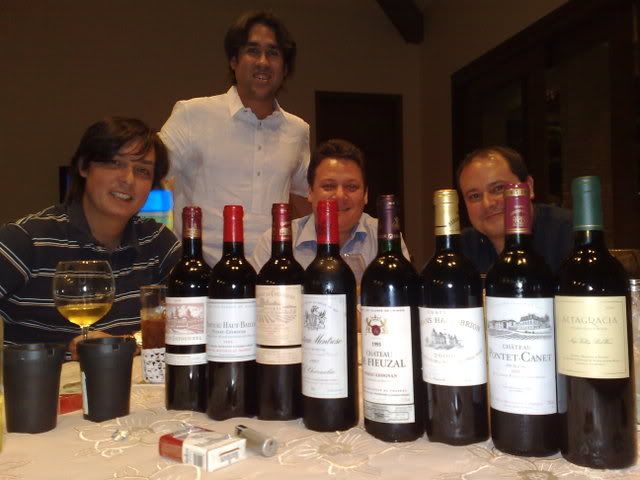
1995 Château de Fieuzal (Pessac-Léognan) - My bottle, reputedly the best produced by de Fieuzal before the advent of vintage 2000. I last had this wine over 5 years ago and was very curious how it was coming along. I mentally compared it to the 1996, which is drinking superbly:
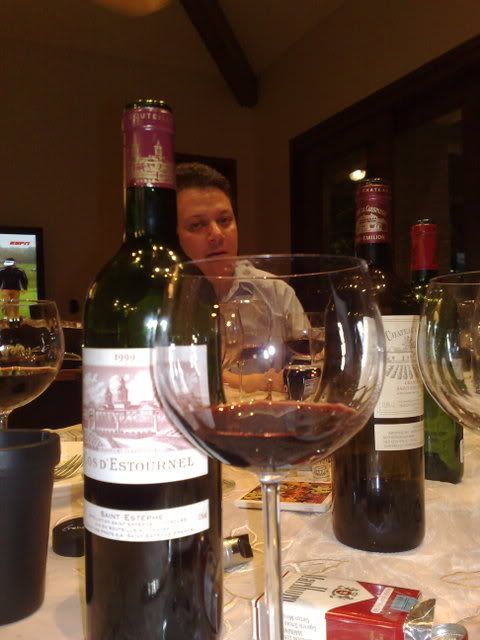 1999 Château Cos d'Estournel (2nd Growth, 1855, St-Estèphe) - Miguel's bottle, and, for me, the wine of the night. I had earlier mentioned to them that most all the dinners I've attended in Bordeaux (in 2006 and 2007) featured the host château's 1999 vintage (e.g., Siran, Léoville Poyferré and d'Issan; plus the 1999 Poujeaux at the recent Commanderie dinner in HK) before moving to far older vintages.
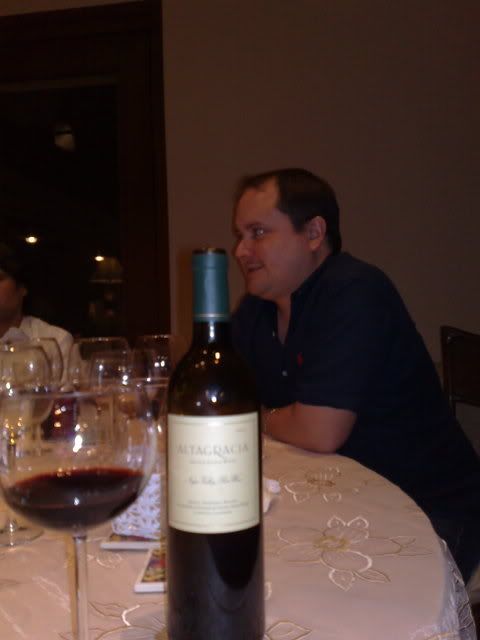
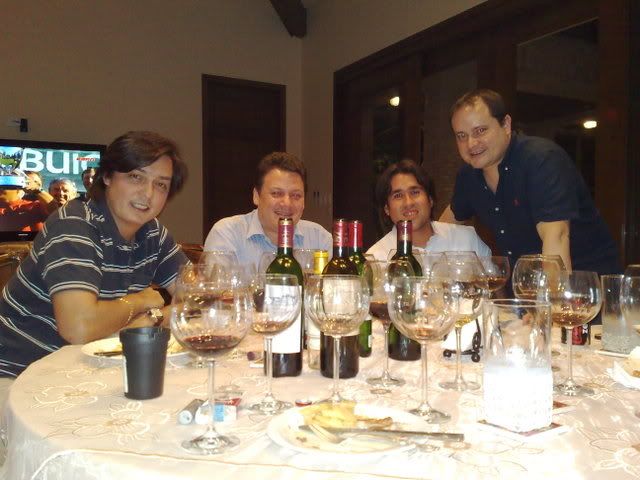
(L-R: Santi, Chris Lozano, Miguel Vecin and Rene Fuentes)
Not wasting any time, to pair with a pâté en terrine of foie gras, Santi broke out a half bottle of 2002 Château de Fargues - from a Sauternes estate of which few people are aware has been owned and run since the late 1700s by the Lur Saluces family of d'Yquem fame. The oldest de Fargues I've had to my immediate recollection was a sublime 1986, enjoyed 3 years ago (See: my old notes).Though it has a lot of maturing to do, this lass is a precocious one; supple with a teen-ager's taut, lithe body and youthfully seductive curves (think Natalie Portman's character in the movie "Closer").
Notes of orange marmalade, orange rind, ripe peach/apricot compote over a slight undertone of crème brûlée are displayed with just enough acid, spiciness and botrytis tang to save the palate from early fatigue.
Lovely, but now I'm going to have to find that DVD of Closer somewhere in the baskets of other videos in my room....With hot-off-the-grill slices of chuleton (with the luscious, irresistible fringes of toasted, life-enriching fat) and various side dishes (scalloped potatoes, marinated peppers, sautéed mushrooms, etc.) , we then moved on to the reds:
1995 Château de Fieuzal (Pessac-Léognan) - My bottle, reputedly the best produced by de Fieuzal before the advent of vintage 2000. I last had this wine over 5 years ago and was very curious how it was coming along. I mentally compared it to the 1996, which is drinking superbly:
Already a lot of bottle-age sweetness to this
medium-bordering-on-full-bodied, ripe, red currant-and-kirsch-laced,
cassis/tar/earth dominant wine with finely knit, with a vaguely smoky, sweetish
roasted herbs and cedar surfacing mid-mouth and following through on the
finish.
The 1995, while holding true to its terroir with typical roasted herbs, mild earthiness and smokiness to the cedar and discreet tar/tobacco notes, lacked the forward sweetish red currant/kirsch push of the 1996 (it was more dominated by dark fruit) and had noticeably less balancing acidity, which, to me, made the former marginally less alluring. I think the 1995 is definitely a good wine, but expected more from it, given its reputation and my fascination with its 1996 counterpart. This just bolsters my (and many others') opinion that the 1996s are definitely better (virtually across the board) than 1995s . At this stage, anyway.
1995 Château Montrose (2nd Growth, 1855, St-Estèphe) - Santi's bottle, chosen by me to compare with the de Fieuzal of the same vintage. I am certain I've had this wine within the last year, but simply cannot find any notes of mine on it. The last I recall clearly was at our beach house during summer around 5 years ago and thinking it was way too young and closed.
In any event, Santi noted that, while the wine was initially reticent, it opened up well around two hours later (he's learned a lot and fast, that one has). Montrose has long been a favored château, it has consistently high quality and can, in good years and after proper age, be powerful yet contemplative as well.
This Montrose was typically masculine, a touch stern and austere, with notes of leather and smoky cedar to its earthy dominant dark fruit and cassis. This is classic St-Estèphe, this Montrose held true and proud to its origins. I thought this and, next, the de Fieuzal paired best with the steaks. This 1995 is more ready to drink than their 1996, I can't think of many wines I could say the same thing for.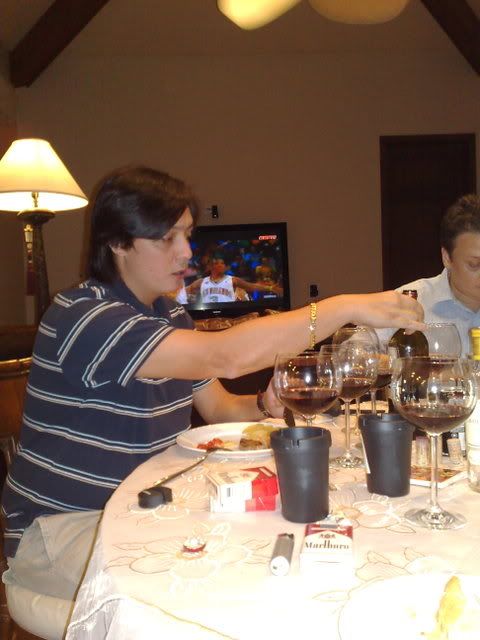 1998 Château La Couspaude (Grand Cru Classé, St-Emilion) - I brought this merlot-dominant wine thinking it would be a nice counterpoint to the left-banks and to pair with the steak. This wine gave me my first win in our regular Mini Blind Bordeaux Challenges so I wanted my friends to try this "giant-killer". All my past bottles of this wine displayed wide-open, generous, almost wanton vanilla/oak-infused, unctuous sweet ripe plum, kirsch, violets, espresso and chocolate profiles on a crowd-pleasing, low acid medium-to-full body.
Unfortunately, this bottle was mildly corked - with a slight hint of of mustiness and plastic and none of the flamboyancy of a healthy bottle. It was still drinkable, but, after a few polite "consolation sips", everyone set their glasses aside - as well they should. There is no reason to plod through a bottle of even mildly corked wine.
Quite disappointing, but, these things happen. Too bad, I really wanted them to be able to try this wine.
1999 Château Cos d'Estournel (2nd Growth, 1855, St-Estèphe) - Miguel's bottle, and, for me, the wine of the night. I had earlier mentioned to them that most all the dinners I've attended in Bordeaux (in 2006 and 2007) featured the host château's 1999 vintage (e.g., Siran, Léoville Poyferré and d'Issan; plus the 1999 Poujeaux at the recent Commanderie dinner in HK) before moving to far older vintages.Cos d'Estournel is widely regarded as the top of the St-Estèphe heirarchy. There are no 1st growths in St-Estèphe - the commune being "ruled" by two 2nd growths: namely, Cos and Montrose.
Some professional reviewers (like Hugh Johnson) opine, however, (and I agree) that Montrose is more expressive of the appellation's terroir. Be it as it may, Cos is an eccentric, exotic château (with a curious Chinoise pagoda on the estate) that makes a wine virtually sui generis with Asian/Indian spice and Chinese tea notes that make it seductively alluring and marginally easier to identify in blind tastings.
This Cos is well extracted and ripe for its vintage, with telltale traces of its signature Asian spice and tea leaf, touch of soy in its nose and on the back-end of the palate, exquisitely woven into the smoky cassis, cherry, licorice, touch of fig and mildly spiced oak. It needed virtually no aeration to display its favors, it just sang out of the bottle. Good confidence and command without being over-bearing, it put on a solid, definitive and memorable performance. Bravo.
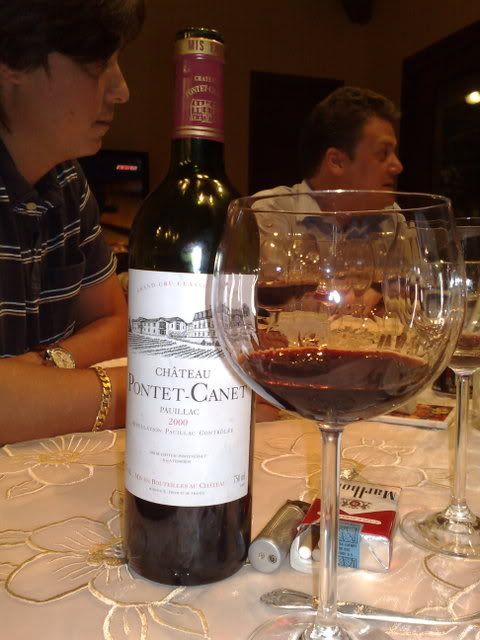 2000 Château Pontet-Canet (5th Growth, 1855, Pauillac) - Chris' bottle, one I had never tried before. This was the young bruiser of the bunch, eagerly unleashing rolling muscle under a lush, ripe, almost velvety glove. Black fruit, cassis over licorice dominated with hints of red cherry, gravel and minerals in a long and strong finish. Good, sturdy bones in this. Impressive for a barely 8 year-old Pauillac, I 'd surely like to try this again in 3 years' time and follow its evolution over the next 20 years.
I suspect this will age nicely (it certainly appears to have the structure for it), the red cherries surfacing more in time and the wine turning subtle and sweeter in 10 years from now.
Though I expected this to be too young to really be enjoyable at this point, I suppose my experience with the 2001 vintage around 2-3 years ago caused me to think this of the 2000 before I tried it. I am happy to admit that I was wrong. Were it that all my mistakes were this pleasurable.
2000 Altagracia (Napa) - Rene's bottle, opened to compare styles and characteristics of origin. I remember it to be a vintage 2000, please correct me if I am wrong. As I understand it, this is the second wine of the cult Napa, Araujo. I've never tried an Araujo, so really didn't know what to expect. Having repeatedly tried a few cult Napa cabs due to the generosity of one-who-cannot-be-named (e.g., Screaming Eagle, Harlan, Bryant Family, etc.), I know well that not all "killer" Napa cabs are over-wrought, contrived, blocky and cumbersome. After all, I, the Doc and Edouard have repeatedly mis-identified well-aged bottles of Dominus from the Stockbroker.
This wine, though, young, was already quite enjoyable. It does not appear to be from the "the bigger, the better" school of wine-making. Though I would certainly not mistake it for Bordeaux or Old World, it does not display the over-bearing, syrupy consistency, tons of oak or telltale coconut-creamy/sweet butterscotch smell of a typical, big napa cab. Rather, it shows comparative restraint (a good thing for me) without sacrificing the straightforward honesty and rich flavors of its its kind.
Big (but not blocky), rich (but not ostentatious), this wine shows off its comparatively viscous, sweetishly ripe molten black fruit, mere hint of pruniness, crème de cassis, licorice, touch of toffee and sweet tobacco with some refinement. I thought it was a nice touch to throw a Napa into the mix. While my heart hopelessly belongs to Bordeaux, the palate can only take so much at one sitting. This wine kept things interesting. As Dr. Lecter quoted his mother in the closing scene of "Hannibal": "It is always good to try new things".
Many thanks, guys. It was a lot of fun. I look forward to the next.
Subscribe to:
Posts (Atom)