Sunday, April 13, 2008

'94 La Mission Haut Brion

Dinner last night at Je Suis Gourmand was with my wife, my children, sis-in-law, the Doc and Mrs. Doc.

After a well-chilled bottle of the Doc's Cerdon de Bugey Caveau de Mont St. July (perfect for a summer aperitif), we proceeded to appetizers of cheese/onion tart, terrine of foie gras, roasted bone marrow and escargot bourgignonne with a bottle of my '97 Béyer Tokay Pinot Gris Comtes d'Eguisheim.

The night's highlight, though, was clearly the red, the Doc had a bottle of '94 La Mission Haut Brion breathing in a decanter when we arrived. Good thing he did too as I had mistakenly taken along a bottle of '01 Jadot Corton Charlemagne instead of the '99 Jadot Chambolle-Musigny I had really intended (I was rushing out and grabbed the wrong bottle, they look so much alike and were beside each other). We would have been without a red last night had the Doc not taken a vinous pre-emptive strike.

With our main courses:

1994 Château La Mission Haut Brion - darkly reflective deep ruby-red, the Doc asked me to guess what it was. I sniffed deeply in the decanter and in glass: mildly truffled, touches of dried herbs and sweet cedar to its dark cherry/raspberry-laced cassis and dark fruit. Before I could hazard a guess, he showed me the bottle. That was when I decided on a crispy goose leg confit for my main course. In the mouth, the wine had an elegantly lithe, silken medium-body that mirrored its nose with subtle "tarry" undertones and perfect acidity which lent it precise balance. The finish had adequate length.

I thought it was elegant, the fruit was clean, pure and honest, not over-ripe/sweet/pruney or obvious like many these days. I know it sounds trite, but this was truly classic Bordeaux - properly reserved, yet not at all stingy with its charms. Along with Angelus, this is one of the best '94s from Bordeaux I have ever had.

The Doc mentioned to me that Parker gave it a "91". I'm not surprised I liked it so much then. I've mentioned before that, when it comes to Médoc wines, my personal RP "sweet spot" seems to be in the rough range of "87-92". Wines he rates above that, I usually find a tad low on acid and obvious - lacking mystery.

I must mention that the wine was an absolutely wonderful pairing with my goose leg confit. I initially was caught between that and beef cheeks or maybe rack of lamb. The reason why I eventually chose the confit was because I figured the red wine sauce of the beef cheeks and the lamb would draw the spotlight away from the wine, while a simple, hearty, no-sauce confit would graciously allow the wine center-stage for the evening.

I figured correctly, the crisp skin and soft flesh's mild flavors allowed the wine to shine, playing with the savory , earthy cassis/herbs/tar, and the sweetish cherry/red berry notes adding enjoyable contrast and interplay. Memorable meal.

Wednesday, April 9, 2008

Wednesday Lunch: 9 April 2008

Lunch today (Wednesday, 9 April 2008) was back at the Tivoli. Just the Stockbroker and I this time, as the Doc was busy and Edouard is in Bordeaux attending to the April en primeur tasting of Siran.

With appetizers of, among others, salmon sashimi, smoked salmon, fresh oysters on the half-shell, bite-sized crab cakes and paper-thin slices of assorted Italian ham, a bottle of my 1999 Henri Bourgeois Sancerre "La Borgeoise". I also brought along a 2001 Corton Charlemagne by Jadot and a 1997 Tokay Pinot Gris Comtes d'Eguisheim by Léon Beyer, but I decided to go with the Sancerre since I knew the Stockbroker favors the oysters and, in my opinion, the Sancerre would be the best match of what I brought.


Consistent with my previous, recent notes:

Quote:
A fuller, richer kind of Sancerre (sauvignon blanc) from one of the area's top producers. The "La Bourgeoise" is, I understand, one of their better bottlings which, atypically for Sancerre blanc, is better aged for several years before consumption.

Those looking for an ultra-fresh, grassy, gooseberry/grapefruit forward sauvignon blanc had better stick to Marlborough, New Zealand SBs as this is a different animal. Sancerres, though also crisp, refreshing and palate-cleansing, are more understated, refined and have a subtle, though unmistakable, white minerality to them. I look to them to pair with more delicate seafood dishes...


I can add that this bottle poured a deeper, more luxurious looking golden wine with nuances of ripe guava, admirable balance, refreshing crispness and bracing minerality. These deftly and definitively cut the salmon's natural fattiness, brightened the mini crab cakes and ran with the oysters' sea-freshness.

To go with my main course of rare tenderloin and the Stockbroker's Chilean sea bass, his bottle of 1996 Grand Cru Romanée St. Vivant by Hudelot-Noellat.


We didn't decant it, choosing to leave it open and let breathe in our glasses as we had our appetizers. Right off the bat, it displayed a wonderful bouquet of Burgundy-decay-laced violets/earthy dark red cherry/beetroot with slight craisin (mid-palate) and strawberry (more to the back and finish) nuances; all of which were mirrored in the mouth in a silky, medium-full body.

Intricately layered and complex, a wonderful middle where so much interplay was going on, I held each sip in my mouth longer than politely possible before slowly swallowing. Sucking in some air at mid-mouth released more nostalgic violets and decay. Long earthy beetroot/red berry/strawberry finish.

From first sniff to the last, whistful note of strawberry, one word kept coming to mind: terroir. Nowhere else on earth produces a wine like this.

Friday, March 28, 2008

A Recommended Cab Sauv/Merlot/Syrah Blend from Italy: 2001 Guado al Tasso by Antinori

Having enjoyed Antinori's 2001 Tenute Marchesi CCR, 2001 Badia a Passignano and 2001 Tignanello several times, I picked up a bottle of the 2001 Guado al Tasso a little over a week ago from the Bacchus Int'l, Shangri-La shop just to try and opened it this past Monday. I understand it is a blend of 60% cabernet sauvignon, 20% merlot and 20% syrah (though I didn't know that at the time, thinking it was another sangiovese bottling).

In accordance with an Italian wine-loving friend's advice, I decanted it and let it breathe for around 2 hours before serving it, though I did take a little bit in the glass after 30 minutes just to see how it was. Initially, the aromas were (unsurprisingly) wrapped in youthful alcohol with nuances of pepper, pine, cedar and camphor. The agressive alcohol interfered with my tasting so I set it aside and waited until the 2 hours were up.

Thereafter, the alcohol had greatly subsided, allowing me to enjoy its plump, nicely-rounded, chewy, full-bodied, highly extracted, low-ish acid, sweet, ripe kirsch/cassis/raspberry-dominated primaries and unabashed notes of licorice, toffee, espresso and mild toasty oak/vanilla. I don't recall detecting in the mouth the pepper nuance in the nose.

Not having had much experience with Italian cab/merlot/syrah blends, if this was served blind to me, I surely would have guessed it to be a young Napa cab blend from a better than average year.

Nice, interesting, I wouldn't mind having it with a good, grilled rib-eye, but I honestly prefer the first-mentioned sangiovese-based wines of Antinori.

Still and all, at the price I got it for (around Php4500) I think it is an acceptable deal and would recommend this wine to those fond of Super Tuscans and predominantly cabernet sauvignon-based Napa reds.

Saturday, March 22, 2008

Vertical Tasting of Château Pichon Longueville Comtesse de Lalande

The International Wine & Food Society held a vertical tasting dinner of Pichon Lalande Thursday before last, 13 March 2008 at Old Manila. 18 persons attended including the French Ambassador, Gérard Chesnel, and William-Alain Miailhe de Burgh who used to administer this then family-owned estate until the early 70s. Thereafter, Michel Delon of Léoville las Cases took over from Mr. Miailhe until 1978 when the château was turned over to Madame de Lencquesaing.

The vintages were:

First Flight: 2001, 1998, 1996, 1995 and 1989.

Second flight: 1988, 1986, 1985, 1983 and 1975 (the 1975 was donated by Mr. Miailhe from Siran's cellar). I'd tried all the vintages before except the 1975 and 1983.

I had earlier offered to donate some 1979, but the Society president said 10 vintages were enough for the tasting.

As most who read my blog are most likely already familiar with this suave, somewhat feminine Pauillac (and, since it is a vertical, many descriptors will wind up being repeated anyway), I will do away with most of the cassis, red berry, earthy, graphite, cedar descriptors.

Though we were to rank the wines, the tasting was not done blind. I pointed out that I felt that since we were to rank the wines, the tasting should have been done blind; otherwise, we should just sit back and enjoy the differences of the vintages without ranking. In any event:

My Own Ranking and Notes (from 1st to 10th):

1st - 1995, because, though it had a somewhat comparatively reticent nose, it had a wonderfully rounded, velvety mouthfeel and a long definitive finish. I ranked it 2nd in my first pass, but switched it to 1st on the second pass. This probably should still be aged more for quite a bit.

2nd - 1985, a comparatively masculine, earthy, truffled PL. Not surprised I liked this a lot, Edouard brought this to one of our blind tasting dinners and it won 1st place over 1985 Mouton Rothschild, 1982 Pichon Lalande, 1988 Léoville las Cases and 1989 Trotanoy.

3rd - 1996, typically elegant style of PL (sweet smelling with just the merest alluring hint of truffle), surprisingly (to me, anyway) lighter than the '95 and it was the least brilliant looking in the flight. Though pure and elegant, it didn't seem to make much of a comparative statement in the mouth.

4th - 1989, as I remember it before, cut from the same cloth as the '95 but a few shades lighter in body. In the mouth, earthy, truffled, a bit gamey.

5th - 1983, very nice PL, one I'd not had before, fine and complex, a bit of resin to the smokey cedar - but in a good way. I remember liking this quite a lot and am surprised now, after reviewing my notes, that I ranked it "only" 5th.

6th - 1975, the Doc, Stockbroker and I commented on how young this 32+ year old wine looked. If served blind, I'm sure that I would not have guessed it to be the oldest by its looks. Very nice for a '75, definitely mature and well preserved, but not much weight or mouthfeel and a bit short.

7th - 1986, this is the third time I've tried this vintage, and it is the third time I was less than impressed. Definitely not the typically elegant PL, or even attractively butch like the 1989 or 1985. The flavors seem superficial, the finish, again, short with a disturbing hint of astringency.

8th - 1988, I had this many years ago and found it a bit hollow, not much of a middle. My current notes state: "Kicking up truffles/gamey, warm feel but with a finish that ends abruptly".

9th - 1998, lightest color of the 1st flight, bit of tin and minerals hovering above the sweet craisin, slightly herbaceous nose. Flavor separation detected, comparatively green, weak middle.

10th - 2001, good structure though still quite youthfully astringent. Not quite enjoyable at this point; not for me, anyway. Though I reserve judgment now, I couldn't help but rank it 10th. Not very fair, I know, but, there it is.

Group Ranking (Weighted Scores):

1st - 1975
2nd - 1989
3rd - 1985
4th - 1986
5th - 1996
6th - 1995
7th - 1988
8th - 1983
9th - 1998
10th - 2001

Thursday, March 6, 2008

Recent Wines.

For the most part of this past month, I've been drinking wines I've already posted on, hence, the dearth of new notes. Some "new" ones though were:

1998 Léon Beyer Tokay Pinot Gris Reserve (Alsace, France) - Typically dry in the Beyer style, but even drier, marginally less floral, fruit-driven, less lush and generous, but, more masculine, well-knit, better focus and balancing acidity than their Comtes d'Eguisheim bottling (i.e., grand cru, but the Beyers eschew the use of this classification) of the same vintage.

This smooth, pleasantly rounded Reserve is more food friendly, in my opinion, as its drier, more self-reserved character lends it more versatility. I've tried it successfully with Marc Aubry's excellent venison and arugula salad (14th February Valentines dinner at Je Suis Gourmand with old friends), and, with Peking duck (first way: skin in pancakes as suggested to me by Catherine Faller) and spicy deep-fried pork spare ribs during a Cantonese dinner with the Manila Gentlemen's Club (22nd February at the Tower Club's Taipan). The wine's cool, plump fruit deftly eased the chili burn and refreshed the palate while allowing the food's underlying flavors to linger somewhat.

Purchased at Bacchus Int'l's Shangri-La shop. I recall I bought out the remaining stock, but, who knows, there may be a bottle or two inadvertently hidden away there somewhere.

1999 Henri Bourgeois Sancerre "La Bourgeoise" (Sancerre, Loire, France) - A fuller, richer kind of Sancerre (sauvignon blanc) from one of the area's top producers. The "La Bourgeoise" is, I understand, one of their better bottlings which, atypically for Sancerre blanc, is better aged for several years before consumption.

Those looking for an ultra-fresh, grassy, gooseberry/grapefruit forward sauvignon blanc had better stick to Marlborough, New Zealand SBs as this is a different animal. Sancerres, though also crisp, refreshing and palate-cleansing, are more understated, refined and have a subtle, though unmistakable, white minerality to them. I look to them to pair with more delicate seafood dishes. In addition, they are one of the few wines that can pair with dishes involving light tomato sauces (tomato is generally difficult to pair wine with).

During a dinner at Jasen and Jen Ko's residence last 23rd February, I opened 3 whites ('98 Tokay Pinot Gris Reserve by Léon Beyer, '99 Sancerre "La Bourgeoise" by Henri Bourgeois and '04 Saintsbury "Brown Ranch" Carneros Chardonnay) to see which would pair best with the pasta course of crab in a light tomato-cream based sauce. The Sancerre was the best match by a mile.

Some of the most memorable Sancerre pairings I've had was with a young, simple, inexpensive '06 La Graveliere by Joseph Mellot (under 40Euros per bottle at Au Pied de Cochon, Paris) which went excellently with the moules farci (small mussels hidden in a spicy, garlic-laden, tomato-based sauce), os a moelle (roasted bone marrow) and a plate of assorted fresh oysters. It also does great with spaghetti vongole.

2000 Château Feytit-Clinet (Pomerol, Bordeaux, France) - From Don Santos during the same dinner at the Ko residence, paired with nicely grilled US prime rib-eye steaks (I must add that Jen has definitely mastered grilling steaks!).

A dark, opulent, lushly rich Pomerol from a nicely ripe vintage (unlike the 2003 vintage, the wines of which I find a bit over-the-top, overly fruit-driven, low on acid, virtually New World in character, and, predictably, will have comparatively limited ageing potential), this precocious wine is already quite open for business at just a shade over 7 years old.

Like most all wines from Bordeaux's right bank, it is made up predominantly of merlot and displays Pomerol's typical power (as opposed to the wines of neighboring St-Emilion which are, generally, softer and gentler) and comparative heftiness. The subject wine is big, fleshy, masculine muscular, yet smooth on the palate and generous in its dominant ripe dark plum, black cherry, licorice and underlying black coffee flavors - the phrase "an iron hand in a velvet glove" comes to mind.

Its powerful character seems typical of the terroir as the winery and its vineyards are located a stone's throw from Châteaux Latour a Pomerol and Clinet - the wines of which are similarly masculine and powerful and can be quite burly and sullen when young.

1994 Château Angelus (St-Emilion, Bordeaux, France) - From Paco Sandejas during dinner on the 19th February at Sala Bistro in Greenbelt 3. Alongside a '99 Léoville Poyferré from me, this was one of the wines Paco, the Doc, I and our wives (though Christine bailed out on us at the last minute - she likely didn't feel like wading through rush hour traffic from Alabang) had with thick prime porterhouse steaks. Actually, Paco gave me a choice between the subject wine and a 1985 Montelena cabernet sauvignon (Napa, California, USA), but, since I hadn't tried the '94 Angelus since mid-2001, I was very curious how it had evolved since then, and, consequently chose that.

My old notes on the wine state that there was a brooding heaviness and reluctance to the wine's dark plum/red fruit/black olive earthiness back in 2001. Well, almost 7 years later, at the mentioned dinner, that was certainly not the case. Despite the lack of decanting and material brething time in the glass, the '94 Angelus was singing with an open, complex bouquet of sweet red cherry (kirsch as well?) over some modestly ripe (definitely one of the riper '94s I've tried, a vintage of Bordeaux that is reputed to have greenness to its fruit), dark plum, faint black olive, spice, cedar and a touch of camphor. There was a nice, mild underlying earthiness to it. These profiles were mirrored on the palate in a lush, medium-to-full body.

The finish was a bit short, but very forgivable considering its vintage, alluring bouquet and generous middle. Over-all, one of the best '94 Bordeaux I've had.

2000 Dominus (Napa, California, USA) - From Miguel Aboitiz during a most enjoyable dinner prepared by his better half, Barbara, on the 29th February. I had this with the rib-eye course, of course.

If served blind, I would almost certainly not have been able to identify it as a California wine by smell alone. I've also mis-identified the Stockbroker's Dominus '91 and '95 vintages as well in the past - not very surprising, I console myself, considering Dominus belongs to the Moueix stable of Pétrus fame. Significantly, though Moueix's Pétrus is arguably the most famous Pomerol - and, therefore, he is recognized by many as the king of merlot - Moueix chooses to work predominantly with cabernet sauvignon in Napa.

In any event, there was a lot of smoky cedar to the primary ripe blackcurrant/cassis/violets/espresso forward profiles of this wine - though well integrated. In the mouth, there was definitely power, and a stern, definitiveness to its character - unabashed and unapologetic. And a good thing at that as it had nothing to apologize for. It was rich, ripe, big, generous, but well-focused with sturdy bones for ageing. Though in the nose I may easily have been fooled, in the mouth, there was a telltale sign of Cali-terroir to it - a sort of toffee liqueur/dried coconut-vanilla-creaminess that usually tips me off to a wine being from California. Excellent with the steak.

1999 La Clusière (St-Emilion, Bordeaux, France) - From the Doc, during the above-mentioned dinner of Miguel and Barbara. I had it with the lamb course. Though I've tried this wine thrice since (all from the Doc), I only have my old notes of 2005:

In the nose, an intense, herbaceous, somewhat earthy dark plum.

In the mouth, confident, unself-conscious, demurely curved, supple mouthfeel,
likewise medium-bodied. Not surprisingly, primary fruit was earthy dark plum but
complexed by finely-knit notes of cassis, violets, mocha and black coffee.

What struck me most about this wine was how the seamless mix gently fell into
layers at the long, long finish. It was a virtual parade, as if each layer of flavor made it a point to bid a short farewell as they all gathered to leave. I shall always remember the wine for this.

Approximately three years later, I note that I did not detect anything particularly herbaceous in the bouquet and must add that the nose is more elegant (as opposed to its earlier intense eagerness), displaying sweetish ripe cherry/kirsch over a dark plum base and lavender notes.

As regards the palate, I believe my old notes are still applicable, though the wine has obviously "come together" more, resulting in a better-knit, smoother over-all impression.

1998 Léon Beyer Gewürztraminer Signature Grains Nobles (Alsace, France) - which I brought to the same dinner for dessert purposes, aside from my '98 Beyer Rielsing Comtes d'Eguisheim for the scallop salad course.

The words "Signature Grains Nobles" or "SGN" signify that the grapes were heavily subjected to botrytis cinerea, a mold that is encouraged to attack and shrivel the grapes causing, among others, their sugars to concentrate and intensify. This is the same method used in the more well-known Bordeaux areas of Sauternes and Barsac on semillon and sauvignon blanc grapes to produce the likes of Yquem and Rieussec. In Alsace, the grapes used can be gewürztraminer, tokay pinot gris or riesling.

Wines made from gewürztraminer have a very distinctive spicy, floral, lychee-dominant smell and taste. Once you've tried one, it is quite easy to recognize and identify later on. I recall the small medieval town of Riquewihr in Alsace was permeated with the smell of gewürz in late September - after harvest and, likely, during crushing time.

The subject wine had a heady, floral, spicy, ultra-ripe lychee-dominant, sweet ripe peach and, to a much lesser extent, apricot with an underlying minerality. Luxuriously mirrored in the mouth, it had good heft, a tanginess/spiciness and healthy acidity which kept it from being cloyingly sweet. Loved it.

Still available at Bacchus at around P4750 (approximately US$115 at the current rate of exchange), I think it's a great buy.

2001 Les Forts de Latour (Pauillac, Bordeaux, France) - I purchased a case and a half of this back in early January 2005, tried some and forgot about them for a few years. My old notes from 30 January 2005 were:

Latour's grand vin has always been a favorite of mine for special occasions.
Needless to state, it is too expensive for me to have everyday. Tonight,
however, was the first time I've tried their second wine. I purchased 1-1/2
cases of it on sale from the Wine Exchange (Anaheim) at around US$37 per bottle.
It retails in Manila at Php6,200 per bottle, which is equivalent to
approximately US$112.32, so I ordered sight unseen because it seemed too good a
deal to pass up.

The wine does recall the grand vin's distinctive somber black currant, cedar
and earth, underpinned by mild cigar tobacco and faint leather. The body is
noticeably lighter (medium bodied at most) although the texture is still quite
round and pure. The length is noticeably shorter than that of its "bigger
brother", but most adequate nonetheless. Nowhere near as complex, but far from
being unsophisticated. Not contemplative, but merits thought.

Overall, I couldn't be happier with this purchase. Classic, fine Pauillac
performance at a readily affordable price. One could pop one open anytime one
wants.

While rummaging through my wine fridge the morning before Miguel and Barbara's dinner, I came across some of the "forgotten" bottles and decided to try one out for lunch that day as I was to scheduled to break bread with a couple of fellow EO members from the Vancouver Chapter.

Decanted for about 45 minutes before trying it out, the dominant profiles remain to be typical Pauillac cassis, graphite, cigar tobacco and faint leather. I noted, though, that the wine now showed nuances of violets, had gained substantial heft and breadth, displaying an expansive middle and a confident, definitive finish. It had a nice, mild chewiness about it, very smooth and well-rounded on the tongue.

Still not what I could call contemplative, but it was certainly enjoyable and a none-too-shabby lunch red. At my $37 mentioned acquisition cost per bottle, it was an absolute steal. Unfortunately, a quick check on the web shows the cheapest price per bottle of this wine is now $119, exclusive of state sales tax and delivery charges.

Wednesday, February 20, 2008

Village Morey St-Denis: Dujac & Jadot

Let me begin with saying that I think Domaine Dujac likely makes the best village Morey St-Denis, to my taste, anyway. In addition to this, its prices are such that one need not wait for a particularly special occasion to pop one open. I've enjoyed, to my immediate recollection, the '95, '96, '97 and '99 (all in Côte d'Or so there was little chance of travel-related deterioration).

1997/1999 Dujac Morey St-Denis - Both vintages are expressive of the terroir and are what one expects from Morey St-Denis from their respective vintages. The '97 is more open, forward, lush and ripe than the '99 and exhibited more sweetish red fruit and red beet nuances than the latter (not surprising). The '99 had a comparatively burlier, darker and earthier over-all character with more depth and focus to its fruit. I think the '99 will hold itself together much longer than the '97.

I would recommend both without hesitation, though I would drink the '97 on its own and would have the '99 with a fat, hearty roast pigeon. Last I checked, the '99 is available in the US at under $65. I, however, unfortunately had to pay restaurant prices in Euro, but enjoyed the bottles nontheless.

Not having any village Dujac Morey St-Denis on hand during this past Valentines (a crisis since I was to have a main course of Marc Aubry's roast pigeon), I was happily surprised to find some 1997 Jadot Morey St-Denis at Bacchus Int'l. - The cork was absolutely pristine and the wine immediately offered up a seductive bouquet perfumed with violets and the slightest hint of vanilla cream. Wide open and generous, ripe dark cherry and raspberriy layers dominated the palate with, again, slight undertones of violets, and, some plumminess underneath, all on a lushly curved medium body.

This wine had a feminine touch and delicacy to it, unlike the earthier, masculine Dujacs previously mentioned. Focus could have been much better and the flavors did display some separation towards the back. Length was adequate at best. Still and all, it was a very enjoyable bottle, and, at around the equivalent of $55 (P2,340.00) for an immediately available Morey St-Denis fix, I cannot reasonably complain. On the contrary, I am going back for more.

I'd drink up now and soonest, it seems on the cusp of decline - something I am not at all averse to. Personally, good red burgs at this point of maturity and slightly past, at times possess a wistful air of decay and nostalgia that I find irresistible.

Saturday, February 9, 2008

A Pigeon and A Pichon.

Was treated to lunch today at Choi's Garden, a new Chinese restaurant I'd been hearing good things about - specifically, it serves good roast pigeon with toasted salt - one of my favorite Cantonese dishes. Who better to have a good Cantonese lunch with than IWFS directors Oscar Ong (who hosted the lunch) and Bernie Sim (who brought the red wine)?

With the shrimp and dim sum courses, I opened yet another 1997 Tokay Pinot Gris Comtes d'Eguisheim by Léon Beyer (which I set aside when having the excellent shark's fin soup so I could concentrate on the soup's delicately complex flavors and textures).

With the pigeon (which, I must say, was likely the best I've had in the Philippines), Bernie opened a 1990 Pichon Baron - Beautiful bouquet of ripe, sweet red cherry/raspberry/kirsch/camphor/cedar over warm, earthy cassis with touches of menthol, graphite, licorice, truffle and violets. A handsome dark ruby-red wine that flowed languidly in the glass, it displayed its generously ripe flavors in exquisite layers. Multi-faceted, complex, healthy extraction (but not overdone) and most admirable balance. Luscious mouthfeel, it exists for sheer enjoyment. A textbook in hedonism without being loud, heavy-handed or over-the-top.

I must note, as well, that it wears its almost 18 years superbly. Not even a hint of tiring here.

Some may recall that I've always had difficulties with pairing Chinese food with red wine. Well, I must bow to the master. I felt that Bernie's red was a wonderful match with the pigeon. The wine had enough power not to get lost in the pigeon's juicy, oily richness yet did not over power the same. The lush, sweet ripeness served as a wonderful counterpoint to the dish's earthy-and-salty savor.

I've never experienced such a wonderful pairing of red wine with Chinese food. If that were not enough, it was a pairing with one of my favorite Chinese dishes.

Many, many thanks guys. I'll always remember this lunch.

Monday, February 4, 2008

Barrel Tasting: 2006 Anne Gros and Daniel Rion

While visiting Vosne Romanée this past October 2007, my wife and I stayed at Anne Gros' maison and got to taste some of her '06s. At nearby Prémeaux-Prissey (just a few minutes drive away), I also got to taste some of the wines of Domaine Daniel Rion through the kindness of Pascale Rion.

Domaine Anne Gros

Anne's whites weren't quite ready to taste yet, so we started with her basic Bourgogne.


Anne's basic '06 Bourgogne is, well, pretty basic and basically pretty - but obviously fuller and noticeably deeper than any other basic Bourgogne I have ever tried, with distinctive plumminess and a dose of violets to the fruit. Her 2006 is noticeable better knit, more focused and polished than her '03 - less ripe too, but anyone even somewhat familiar with the past several vintages of Burgundy would know that, so I won't belabor the issue.

In all, it is a very good basic Bourgogne. If I were to be in the market for basic Bourgogne, I would definitely get some of this (I actually did buy a few of her 2003s for afternoon quaffing in Vezelay).

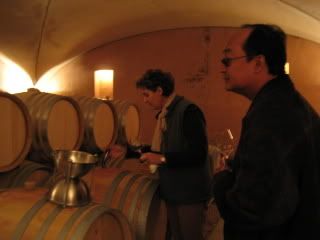
We then descended to her barrel room for the grand crus. Here she is with her wine thief dipping into her '06 Clos de Vougeot as I (a bit too) eagerly look on.


Her Clos de Vougeot is on the full side of medium-bodiedness, rich, ripe and deeply-veined, well-focused with nicely clean, neat layering of primary fruit - the mildly spicy oak/vanilla touch, delicately executed. Wonderful balance. The plumminess to the fruit I noted in the basic Bourgogne and, below, the Richebourg, did not play a major role in the Clos de Vougeot.

We then moved on to her '06 Richebourg. This wine was decidedly full-bodied, rich, lush, generous, with a touch more masculine earthiness and decadence to its (again) plummy dark fruit, mild dark spice and alluring violets, as compared to the Clos de Vougeot. The violets here were sweeter and laced the fruit rather than permeating it as in the basic Bourgogne. The oak/vanilla was marginally more obvious in the Richebourg as compared to the Clos de Vougeot.

In 2007, Anne made an Echézeaux that I hope to get to try next year when it is ready. Madam Gros, Anne's energetic and most hospitable mother, joined us while we tasted the Richebourg.


Domaine Daniel Rion

Pascale Rion at first seemed a little shy, serious and soft-spoken. She has assured me, though, it was only because she was incredibly busy that day (and, indeed, she was as I saw myself). Despite this, however, she still took the time for a brief interview with me at her office, after my tasting. I look forward to meeting her again soon and tasting through her wines.

Anne, on the other hand, is very friendly, has a sharp, dry, mischievous wit, a meltingly charming smile, doesn't take herself seriously and speaks English very well.

Since my wife was a bit groggy from lunch, she didn't join me at Domaine Rion, and I, naturally, forgot to bring my camera. So, no pictures.

Together with one of Pascale's wine analysts, a charming young lady with sandy blond hair, wine-stained jeans and perfect English, I started with the '06 Chambolle Musigny Beaux Bruns - A touch of delicate femininity (which I found characterizes all the wines I tried from this domaine's '06s) to its medium-bodied, black cherry laced dark fruit with mere hints of dark raspberry and hint of cocoa. Good, pleasant, nice clean lines, definitely well-made, very discreet spicy wood; but, somehow it just didn't interest me much.

The '06 Vosne Romanée Beauxmonts was quite alluring, I could say seductive. What grabbed me most about it was the exceptional purity and silkiness of its sweet, dark fruit, dark violet petals and sweetly spiced, gracefully integrated demure wood notes. Elegant wine, definitely. Great balance.

The '06 Clos de Vougeot, as expected was richer, more generous, fruitier than the previous wine, but neither as perfumed, pure nor as fine/elegant as the Beauxmonts at this point. I suspect, though, that this will gain more finesse after several years in bottle.

The '06 Echézeaux, on the other hand, though even bigger and deeper, seemed to have better balance now, with darker fruit and a touch of black berries and red currants, as well as hints of clove to the pinot fruit. Still, there is that underlying feminine sweetness and grace. The oak is more noticeable in this but not to the point of being obnoxious. I suppose this will greatly improve over time - I'd try it again in around 8 years to see how it comes along.

Pairing Alsace Pinot Gris

I've gone through around 5 or 6 bottles of the 1997 Tokay Pinot Gris Comtes d'Eguisheim by Léon Beyer in the past 2-1/2 months, ever since I found them available locally from Bacchus Int'l., and have enjoyed every one of them.

After drinking a lot of pinot gris in Alsace, from the top makers' best bottlings down to unheard-of house wines, I can personally confirm the literature that says it is very versatile with food. I've had it with foie gras (pan-seared and in terrine), Flammekueche (a.k.a., tart flambée), Baeckeoffe, choucroute, Cantonese crispy/spicy pork, Thai lamb curry and prawn crackers dipped in a spicy curried peanut sauce, and, as posted earlier, with an Alsacien stew of quail and foie gras. It matched well, in varying degrees, with each of the mentioned dishes.

Pinot gris wine will never have the crisp, minerally brightness of riesling, but with heavier dishes, such as the quail and foie gras stew, it is, to me, a better match.

The wine is a limpid, gold-tinged full yellow with a heady bouquet of alluringly spiced melon, ripe yellow tropical fruit, touch of lemon drop, moderate vanilla/oak, all mirrored on the palate in broad layers and voluptuously rounded curves. Full-bodied white, ripe fruit, but not at all cloyingly sweet, its acidity was just good enough to support/buttress the generous flavors.

I just had another bottle over dinner tonight with my family at our favorite Thai restaurant. My eldest son, 14 years old, has been having a glass or two with us when out to dinner. Unprompted, tonight, he commented to me that he thought the wine went well with the prawn crakers and curried peanut sauce and the dish of lamb curry. He was absolutely right...it certainly warms the heart to see how he can tell.

Another match I think making special mention of is with a Cantonese dish of deep-fried pork, crispy on the outside and juicy inside, laced with salt and hot red pepper. The wine gently eased the burn and resuscitated and cleansed the palate, its off-dry ripe fruit playing nicely with the pork's salty notes. An excellent match.

There are few bottles left in Bacchus of this wine. I purposely didn't post on it until now to make sure I had gotten a good helping of the Bacchus stock before someone cleans it out. Hopefully, that someone will be me.

With Marc and Léon Beyer (13th and 12th generations, respectively, in the business) in their Eguisheim vineyards:

Sunday, February 3, 2008

2 Rhônes and a Burgundy for Roast Pigeon.

With a main course of earthy roast French pigeon, dinner 2 February 2008:

2000 M. Chapoutier Ermitage Le Pavillon - From the Doc. The overwhelming ripe, richness and power of this big, muscular young bruiser are balanced by surprising focus and purity. Decidedly a huge masculine wine, it would have been all too easy to be awkward and clumsy and it is a testament to Chapoutier's skill and dexterity that this was not the case. While still quite primary, some dark red raspberry highlights manage to twinkle through a lush velvet curtain of thick, woody, leathery ripe dark fruit compote, crème de cassis, touch of licorice, hint of thyme, vanilla and a healthy dose of sweetish dark chocolate.

I'd wait several years on this - at least 8 more, but to re-check in 6.

Enjoyable, but it was too big and alcoholic at this point for my little pigeon.

2003 Domaine de Beaurenard Cuvée Boisrenard - A blast of super ripe, baked, spiced dark fruit wrapped in alcohol. There is depth to the fruit, no doubt, probably very old vines, but its heat just wouldn't let up even though I kept returning to it throughout the evening. Much too young, of course, but I do not think this can age gracefully. Not enough stuffing in too much alcohol. I'm pretty sure it's the vintage speaking. Also quite big, but marginally less than the previously mentioned wine and nowhere near as focused.

Way too much for the pigeon. I couldn't taste any interplay at all. The wine just seemed to kick the bird's flavors right out of my mouth.

1999 Grand Cru Charmes Chambertin by Domaine Taupenot-Merme - The third bottle I've gone through in two months. My previous notes state:


Though only 8 years from vintage, it is already exhibiting its bouquet of age -
a forshadowing of even better things to come, I'd say: deep, darkish pinot noir
fruit primaries very discreetly and intricately laced with well integrated
oak/vanilla and seductive earthy/truffle notes.

In the mouth, what I recall best is its luxurious texture, a relatively full Burg but lithe, not heavy at all. Superior balance and purity. Focus and length were adequate, could be better; but, over-all (considering its price) I was very happy with it and would recommend it in a trice.

After the previous mentioned Rhônes, my Burg felt like a lightweight on the palate, yet, still, its purity and balance shone through. Added alluring lavender and notes of violets in the nose and mouth, together with whispers of the ever-so-hard-to-describe Burgundy decay that I am hopelessly in thrall of.

I loved this wine that evening and it was a good match with my pigeon. Still and all, I think I should have brought something with a little less finesse and a touch more masculine earthiness - I'm thinking something from Morey St-Denis.

Next time.